
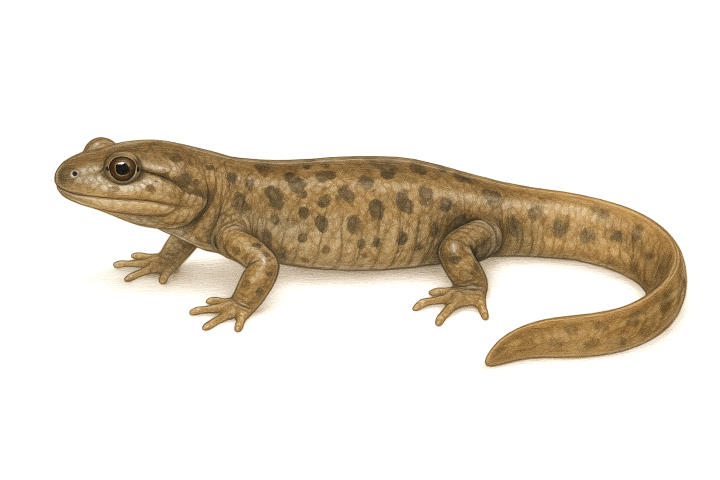
The Coastal Giant Salamander lives up to its name — it’s one of the largest terrestrial salamanders in North America, and its secretive lifestyle makes it feel like a hidden forest legend. With a thick body, bold patterning, and a surprising ability to make vocal sounds (yes, really), this salamander has some fascinating traits that make it stand out in the amphibian world.
Size & Physical Appearance
Coastal Giant Salamanders are big, especially compared to most other salamanders you’ll find in the United States. Adults usually range from 6 to 13 inches long, with some reported to reach up to 14 inches. Their bodies are muscular with large, sturdy heads and blunt snouts.
Color-wise, they’re typically a dark brown, gray, or purplish brown, and their backs are marked with a beautiful, marbled pattern of gold or tan blotches. Juveniles are often brighter and more clearly patterned. As they grow older, their colors may darken and the contrast in their patterning can fade a bit.
Males and females look similar, but during breeding season, males may develop slightly swollen vents and more defined glandular areas around the head. Don’t worry if that sounds a little technical — in general, it’s not easy to distinguish their sexes without a pretty close inspection.
Habitat and Range
These salamanders love damp, cool environments. You’ll usually find them in moist forests, near clear, cold streams or seeps in the Pacific Northwest. They’re most commonly found in:
- Northwestern California
- Western Oregon
- Southwestern Washington
- Occasionally as far north as southern British Columbia
They prefer lower elevations but can be found up to around 5,000 feet in the mountains. Look for them under logs, in mossy crevices, or during wetter seasons when they become more surface-active. In the drier months, they retreat underground or stay submerged in cold streams where they can remain moist.
Diet
Coastal Giant Salamanders are opportunistic carnivores. That means they eat whatever small animals they can catch. Their diet includes:
- Insects
- Slugs
- Spiders
- Worms
- Other amphibians
- Even small rodents or fish on occasion
One cool trait? Adults that keep their larval, aquatic form (more on that below) may feed on aquatic prey like insect larvae and small crustaceans. Their appetite is as sizable as they are!
Lifespan
In the wild, Coastal Giant Salamanders can live up to 20 years. In captivity, with proper care, they can sometimes live even longer. That’s a pretty impressive lifespan for an amphibian, and part of why some people find them so fascinating.
Identification Tips
Trying to figure out if you’re looking at a Coastal Giant? Here’s what to look for:
- Size: Larger than almost any other salamander in its range.
- Color and pattern: Marbled gold or tan markings on a dark brown or purple-brown body.
- Large, broad head: Strong jaws and a sturdy appearance.
- Environment: If you’re in a cool, forested stream zone in the Pacific Northwest, this species is a good candidate.
Don’t confuse them with the Long-toed Salamander or other smaller, woodland species. Those tend to be slimmer and don’t have the heavy build or marbled look.
Also worth noting: some Coastal Giants remain in their aquatic larval form their whole lives — this is called neoteny. These adults have external gills and live entirely in water, which can make identification trickier. But they still keep that same marbled, chunky appearance.
Fun Fact
Most salamanders are silent, but not the Coastal Giant. This is one of the few salamanders that can actually vocalize — it can give out sharp, barking or clicking sounds when it’s startled or feels threatened. Imagine turning over a log and hearing a tiny bark!
Final Thoughts
The Coastal Giant Salamander is a true icon of the Pacific Northwest’s wet forests — big, bold, and surprisingly elusive. Whether you’re a student doing research or a hiker hoping to spot one, knowing what to look and listen for can make the search more exciting. Just be sure to leave logs and rocks as you found them and never handle wildlife unless you absolutely have to. Respecting their space helps keep these gentle giants healthy and thriving in their hidden woodland worlds.