
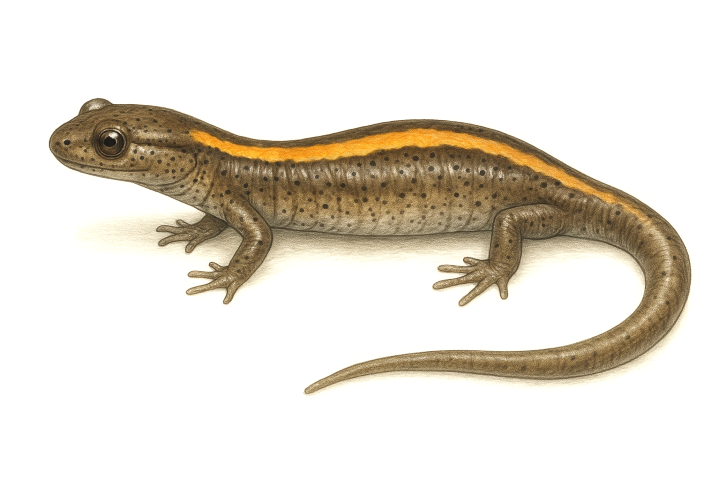
The Coeur d’Alene Salamander is a secretive little amphibian with a cool story. This slender salamander is found only in a few tucked-away corners of the inland Northwest. What makes it special? It thrives near cold mountain springs and waterfalls, and you’ve got to look closely to even spot one. It’s not just rare—it’s picky about where it lives, which makes every sighting feel like a hidden treasure.
Size & Physical Appearance
These salamanders are on the small side. Adults usually measure 2 to 4.5 inches long from snout to tail. They have slender bodies and long legs, which help them scramble around their rocky habitats.
Color-wise, the Coeur d’Alene Salamander is mostly dark brown or black with a bright yellow to orange stripe running down its back and tail. That stripe can be narrow or wide, and it may look almost broken in some individuals. Some salamanders also have yellowish flecks on their sides and legs.
Juveniles look pretty similar to adults but are obviously smaller and sometimes have less defined stripe coloring. Males and females are tricky to tell apart unless you’re studying them up close during breeding season, which most people won’t be doing.
Habitat and Range
This species is a habitat specialist, which means it’s quite picky about where it lives. You’ll usually find Coeur d’Alene Salamanders around cold, moist areas—like springs, seeps, under rocks near streams, or at the spray zone of waterfalls. They need high humidity and constant moisture to survive.
Range-wise, they’re very localized. You can find them in northern Idaho, particularly the Coeur d’Alene Mountains (that’s where they got the name), parts of extreme western Montana, and a few spots in northeastern Washington. They’re usually found in elevations between 2,000 and 5,500 feet, mostly in forested foothills and mountain slopes.
Diet
These salamanders are insectivores. They feed on small invertebrates like springtails, ants, beetles, spiders, and mites. Basically, if it’s tiny and crawling around in the leaf litter or on damp rocks, it might be on the menu.
Because they’re active mostly at night (or on very wet days), they do a lot of their hunting when it’s dark and quiet.
Lifespan
In the wild, Coeur d’Alene Salamanders can live around 8 to 10 years, though studies on their exact lifespan are limited. Like other woodland salamanders, they tend to grow slowly and live longer than people might expect for their size.
Identification Tips
It’s easy to mix them up with other small salamanders if you’re not looking closely. Here’s how to tell the Coeur d’Alene Salamander apart:
- Distinct yellow-orange dorsal stripe: This is the big one. Not all salamanders in the area have this bright stripe down their back.
- No lungs: Like other members of the Plethodon genus, they breathe through their skin. Of course, you won’t see that, but it’s why you find them in super moist microhabitats.
- If you’re unsure, check the location: If you’re in northern Idaho near a cold rocky spring, and you spot a salamander with a bold back stripe, odds are it’s a Coeur d’Alene.
They may be confused with the Long-toed Salamander (Ambystoma macrodactylum), which also has a dorsal stripe—but the Long-toed has a thicker body and is usually found in different habitats. Also, if you see a crowded pond full of larvae, it’s probably not a Coeur d’Alene—they don’t have a free-swimming larval stage.
Fun Fact
This salamander doesn’t go through a tadpole or aquatic stage like frogs do. Instead, it skips straight from egg to tiny salamander in a process called direct development. The eggs are laid in moist cracks or crevices, and when they hatch, out pops a tiny version of the adult—no swimming required!
Whether you’re hiking through northern Idaho or just curious about lesser-known amphibians, the Coeur d’Alene Salamander is a great reminder that some wildlife thrives in small, hidden places. If you do spot one, enjoy the moment—but make sure to leave rocks and logs undisturbed, so these little salamanders can keep calling those hidden mountain springs home.