
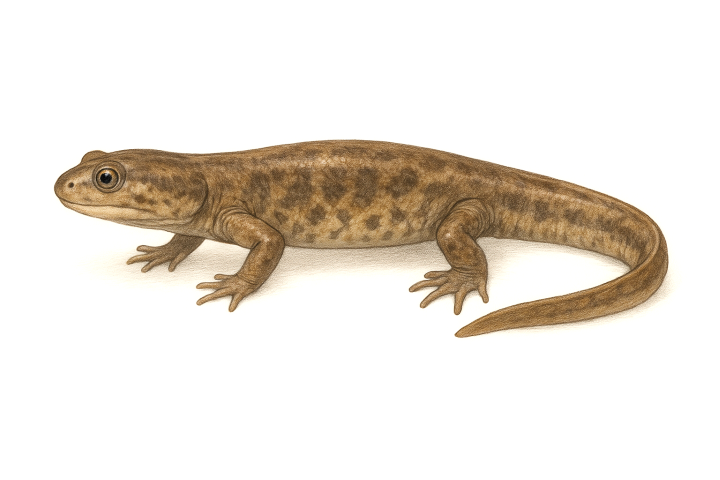
Cope’s Giant Salamander is a fascinating amphibian that stands out for staying underwater its entire life. Unlike many salamanders that grow lungs and live on land as adults, this species keeps its gills and never leaves the water. It’s secretive and a bit mysterious, living in cold, fast-moving mountain streams deep in the Pacific Northwest. If you’re lucky enough to spot one, you’re seeing a creature that’s perfectly adapted to a very specific and wild corner of the U.S.
Size & Physical Appearance
Cope’s Giant Salamander is considered medium to large for an aquatic salamander. Adults usually measure between 4.5 to 7.5 inches long, although some can grow up to 9 inches. They have large, broad heads, short limbs, and thick bodies.
Their coloration ranges from mottled brown to grayish-brown with marbled or speckled patterns that help them blend into the rocky streambeds. One standout feature is the set of external feathery gills that they retain as adults — a sign of their fully aquatic lifestyle.
Juveniles look pretty much like the adults, just smaller, and males and females are difficult to tell apart without close examination.
Habitat and Range
Cope’s Giant Salamander is a true Pacific Northwest native. You’ll find it mainly in western Washington and northwestern Oregon. It sticks to cool, clear, and fast-moving mountain streams — often in forested areas where the water stays cold year-round.
This species lives at low to mid elevations, typically below 4,500 feet. It hides under rocks or logs in streams and does not venture far from water.
Diet
These salamanders are carnivorous and feed on a variety of aquatic prey. Their diet includes:
- Insects like mayfly and stonefly larvae
- Small crustaceans
- Worms
- Sometimes even smaller salamanders or fish fry
They are ambush predators, sitting still and snapping up prey that gets too close.
Lifespan
In the wild, Cope’s Giant Salamanders probably live around 10 to 15 years, though they could live longer in ideal conditions. In captivity (mostly in research environments), they’ve been known to live a bit longer, but this species is rarely kept in aquariums because of its habitat needs.
Identification Tips
Since there are other large salamanders in the Pacific Northwest, it helps to know what sets Cope’s Giant Salamander apart.
- It retains its external gills even as an adult. That’s called being “neotenic,” and it means it doesn’t undergo the typical land-based metamorphosis.
- Compared to the closely related Pacific Giant Salamander (Dicamptodon tenebrosus), Cope’s Giant Salamander is smaller on average and almost always stays aquatic.
- Pacific Giants sometimes leave the water and develop lungs; Cope’s do not.
- Look for a more rounded head and slightly more muted coloring than its close relatives.
If you see a large, fully aquatic salamander with gills in a fast-moving Pacific Northwest stream, there’s a good chance it’s Cope’s.
Fun Fact
Cope’s Giant Salamander is one of the few salamanders that doesn’t bother going through a full metamorphosis like most amphibians. It just sticks to its underwater lifestyle, keeping its larval gills for life — no lungs, no climbing onto land, just pure aquatic living!
Evolutionarily speaking, it’s like a salamander that’s frozen in its teenage phase — and totally thriving.
Wrapping Up
Cope’s Giant Salamander might not get the spotlight like frogs or colorful newts, but it’s a quiet marvel of mountain ecosystems. If you’re hiking near a cold, forested stream in western Washington, take a moment to peer into the water. With a little patience, you might just spot one of these underwater giants tucked beneath a rock — living proof of how diverse and specialized amphibians can be.
Just remember: always look, don’t touch. Their habitats are delicate, and these salamanders have made a home right where they belong.