
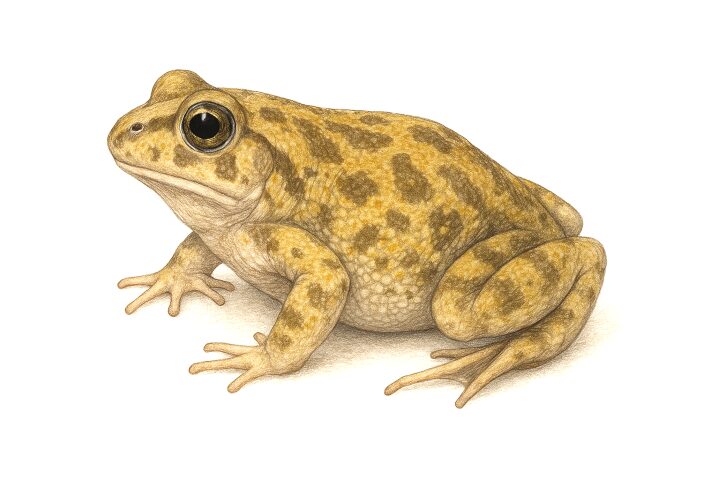
The Couch’s Spadefoot is one of the desert’s most elusive amphibians, famous for its ability to stay underground for months—sometimes even years—waiting for the perfect summer storm. When heavy rains finally arrive, these toads emerge in massive numbers to breed in temporary pools, making them one of the Southwest’s most dramatic amphibian spectacles. If you’ve ever seen a toad just appear out of nowhere after a summer downpour in the desert, chances are it was this little survivor.
Size & Physical Appearance
Couch’s Spadefoot toads are relatively small, usually ranging from 2 to 3.5 inches long. They have a stocky, rounded body with smooth, almost soft-looking skin. Their coloration usually matches the sandy desert—yellowish, olive, or greenish-gray, often with irregular darker splotches or spots. This color helps them blend into arid surroundings remarkably well.
One standout feature is on their back feet: a black, wedge-shaped “spade” on each hind foot, used for digging into the sand. This is actually where all spadefoot toads get their name. Males are typically smaller and may appear more vibrant during the breeding season. Tadpoles and juveniles are tiny and dark, quickly growing as they race to metamorphose before the water dries up.
Habitat and Range
Couch’s Spadefoot is a true desert dweller. You’ll find it across the southwestern United States, especially in Arizona, New Mexico, Texas, Oklahoma, Nevada, and southeastern California. Their range even extends south into northern Mexico.
They favor arid and semi-arid environments like desert flats, grasslands, and scrublands, especially areas with loose or sandy soils for easy burrowing. Elevation-wise, they occur from sea level up to around 5,000 feet.
Diet
In the wild, Couch’s Spadefoot eats a variety of insects and other invertebrates, especially ants, beetles, termites, and grasshoppers. They’re opportunistic feeders, which means they’ll eat pretty much anything that fits in their mouth when they get the chance—especially after a rain, when insect activity spikes.
One interesting note: the tadpoles of this species are known to be both fast-growing and surprisingly adaptable. In some cases, they have even been observed eating other tadpoles if resources are limited and pools start drying out—nature can be tough.
Lifespan
In the wild, these spadefoots can live for about 8 to 10 years, though many don’t make it quite that long due to harsh conditions and predators. In captivity, with consistent care and a stable environment, they may live a bit longer.
Identification Tips
There are a few other spadefoot toads in the U.S., and some of them look pretty similar. To distinguish Couch’s Spadefoot:
- Color: Look for a yellow-green or olive background color with irregular dark blotches.
- Pupils: Their eyes have vertical slit-shaped pupils, unlike most frogs.
- Skin and size: Body is smooth and soft-skinned, not warty like true toads.
- Spades: The hind feet have a well-developed, sickle-shaped black spade for digging—larger and more prominent than in some other species.
- Call: If you hear a loud, sheep-like bleating call at night after a desert storm, it’s likely Couch’s Spadefoot males calling from temporary puddles to attract mates.
Fun Fact
Couch’s Spadefoots can spend up to 11 months a year underground, sometimes even longer if rainfall is scarce. They go into a state called estivation, sort of a desert version of hibernation, lowering their metabolism and sealing themselves in moist burrows to wait out the dry heat. It’s an incredible adaptation that allows them to thrive in some of the harshest habitats in North America.
Next time you’re in the desert right after a big summer thunderstorm, listen carefully. You just might hear an excited spadefoot calling from a roadside puddle—living proof that even in the driest landscapes, nature finds a way.