
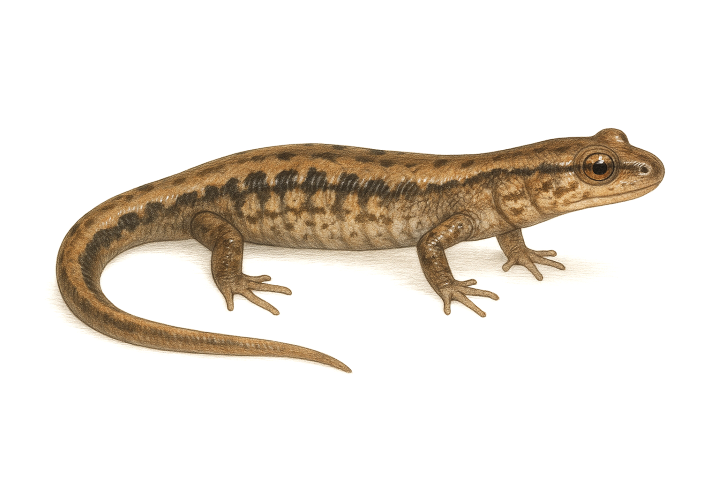
The Cumberland Dusky Salamander is one of those quiet, elusive forest dwellers that you could walk right past without ever knowing it’s there. Secretive and well-camouflaged, this slim little amphibian is only found in a small slice of the southern Appalachians. It’s special not just because it’s rare, but because it plays a crucial role in the health of mountain stream ecosystems. If you’re lucky enough to spot one, you’ve had a rare glimpse into a hidden world.
Size & Physical Appearance
This salamander is on the smaller side, typically growing to about 2 to 4 inches (5 to 10 cm) in length, including the tail. It has a slender body, a relatively short tail compared to some other dusky salamanders, and well-developed hind limbs.
Color-wise, the Cumberland Dusky is usually a dark brown to blackish color with scattered light flecks or subtle mottling. Some individuals may have a faint stripe down the back, but that’s not always obvious. The belly tends to be a lighter gray or brown.
Males and females look pretty similar, though adult males have slightly more prominent mental glands (on the chin) during breeding season. Juveniles look like miniature versions of the adults, though their colors may be a little brighter when they’re young.
Habitat and Range
A true Appalachian specialist, the Cumberland Dusky Salamander is found only in a restricted area of the southern Cumberland Plateau, mostly in Tennessee and a small part of northern Alabama. It favors moist, rocky environments near cold, clear streams—especially on forested slopes and ravines. You might also find it under mossy rocks, logs, or leaf litter, where it stays damp and hidden.
Unlike some salamanders that can wander into drier woods, this species sticks pretty close to moist microhabitats. It generally lives at mid–to–high elevations, often above 1,000 feet.
Diet
This salamander is a night-time hunter, eating mostly small invertebrates like insects, spiders, worms, and tiny snails. It uses its sticky tongue to pick off prey from moist leaf litter or stones near streams.
What’s especially interesting is that the Cumberland Dusky Salamander is an opportunistic feeder—it’ll eat whatever small critters are around, which helps it adapt to seasonal changes in food availability.
Lifespan
In the wild, these salamanders are thought to live at least 5 to 10 years, though exact data are limited because of their elusive nature. In captivity, they may live a bit longer with consistent temperature and moisture conditions, but they’re rarely kept outside of research settings.
Identification Tips
Telling the Cumberland Dusky Salamander apart from other dusky salamanders can be a little tricky, especially since several species in the Desmognathus genus look quite similar. Here are a few things to help:
- Tail shape: The tail is usually round in cross-section and shorter relative to the body compared to other dusky salamanders.
- Hind legs and jaw: It has relatively large hind legs and a slightly stocky body. Look for the strong jaw muscles, which give the head a triangular shape when viewed from above.
- Back pattern: Unlike some relatives with distinct dorsal stripes, the Cumberland Dusky’s back is usually more mottled or dark with fine spotting, not a bold line.
- Range: Knowing where you are counts. If you’re herping in the southern Cumberland Plateau, you’ve got a better chance of stumbling across one.
Fun Fact
The Cumberland Dusky Salamander gets its name from Latin abditus, meaning “hidden” or “concealed”—a nod to both its secretive nature and the fact it went unnoticed by science until the late 20th century. It was only described as its own species in 1997, making it one of the more recently recognized amphibians in the U.S.
Wrap-Up
Although it’s small and easy to miss, the Cumberland Dusky Salamander has a big role in the mountain habitats it calls home. It’s also a great reminder that there’s still so much we’re discovering about our native wildlife. If you’re hiking near a cool, shaded stream in the southern Appalachians and spot something scampering under a rock, take a closer look—you may have just found one of nature’s best-kept secrets.