
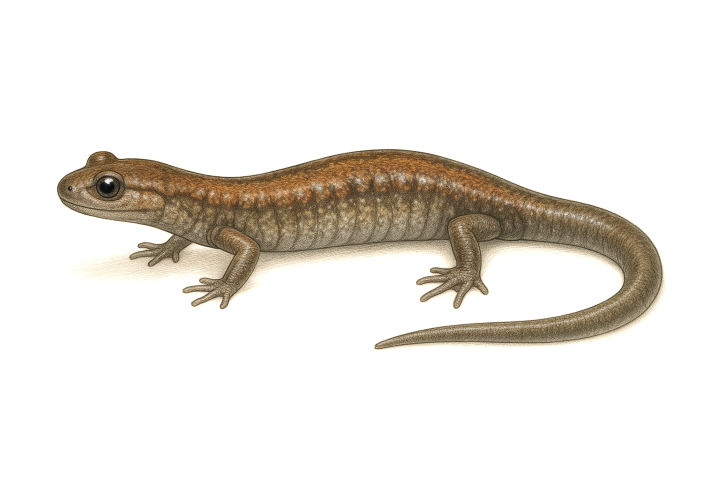
If you’re exploring the damp, shaded forests of far northern California or southern Oregon, you might be near one of the Pacific Northwest’s lesser-known amphibians — the Del Norte Salamander (Plethodon elongatus). This slippery little salamander is known for its slender body, secretive behavior, and love for mossy, cool hideaways. It doesn’t depend on streams or ponds like some amphibians do, which makes it pretty special. Instead, it spends most of its life tucked away under logs or rocks — so spotting one is a real treat.
Size & Physical Appearance
Del Norte Salamanders are on the small side. Adults usually measure between 3 to 5 inches long, but thanks to their thin, stretched-out bodies, they can seem longer than they are.
Their appearance is subtle but beautiful. Most have a dark brown to black base color with a reddish, coppery, or bronze stripe running down the back. Some individuals might be almost solid dark with faint speckling. Their bellies are usually darker and can be gray or black. Juveniles look similar to adults but are smaller, and some may have brighter dorsal stripes early on.
Unlike some amphibians, males and females look very similar, though during the breeding season, males may have slightly swollen glands near the chin area. You’re unlikely to notice this in the field unless you’re looking closely.
Habitat and Range
The Del Norte Salamander sticks to a fairly small slice of the Pacific Northwest. It’s mainly found in northwestern California and the extreme southwestern corner of Oregon. Think areas like Del Norte County (which gives the salamander its name) and parts of Siskiyou and Humboldt counties.
It prefers cool, moist forested environments, especially mature coniferous forests with plenty of decaying logs, bark, rocks, and leaf litter. These salamanders usually live in lower to mid elevations, often between 1,000 and 5,000 feet, though they can occur both higher and lower depending on microhabitat conditions.
Unlike frogs that rely on ponds, the Del Norte Salamander doesn’t need standing water. That’s because it’s part of the lungless salamander family (Plethodontidae), and it breathes through its skin. This means it must stay moist, so you’ll mostly find it in very damp places.
Diet
This little salamander is a tiny but skilled predator. Its diet consists of small invertebrates like:
- Springtails
- Ants
- Beetles
- Small spiders
- Other soft-bodied arthropods
They hunt mostly at night or during damp, cool days when they come out from hiding. Their feeding strategy is all about stealth — waiting quietly and striking quickly.
Lifespan
In the wild, Del Norte Salamanders can live for 5 to 10 years, possibly longer. There’s still a lot scientists don’t know about their long-term habits because they’re so secretive.
They’re rarely kept in captivity, so lifespan data outside the wild is limited.
Identification Tips
Because of their small size and earthy colors, Del Norte Salamanders can be tricky to tell apart from other western Plethodon species, like:
- Siskiyou Mountains Salamander (Plethodon stormi): Very similar but usually has a more speckled or granular appearance along the sides and may live at slightly higher elevations.
- Dunn’s Salamander (Plethodon dunni): Typically found farther north and has a shorter, stouter body and a more yellowish dorsal stripe.
If you’re trying to ID a Del Norte Salamander, pay attention to that slender body shape, the sometimes-metallic reddish stripe on its back, and whether you’re in the right part of its limited range. A salamander with a long, narrow body in a coastal California forest might just be this elusive species.
Fun Fact
Here’s something cool — unlike most amphibians, Del Norte Salamanders skip the tadpole stage entirely. They hatch straight from the egg as tiny versions of the adults! This is called direct development, and it’s one reason they can live far from ponds or streams. All they need is moisture and a safe hiding spot.
It’s just one more thing that makes them perfectly adapted to their forest home.
Wrap-Up
The Del Norte Salamander may not be as flashy as a tree frog or as famous as a bullfrog, but it’s a fascinating part of the West Coast’s wild diversity. If you’re hiking through old-growth forest in northern California or southern Oregon, keep an eye out under logs or leaves — gently, of course. You just might glimpse one of nature’s more secretive residents.
And remember: if you do find one, enjoy the moment, then carefully put their shelter back like you found it. These little creatures depend on the forest floor to survive.