
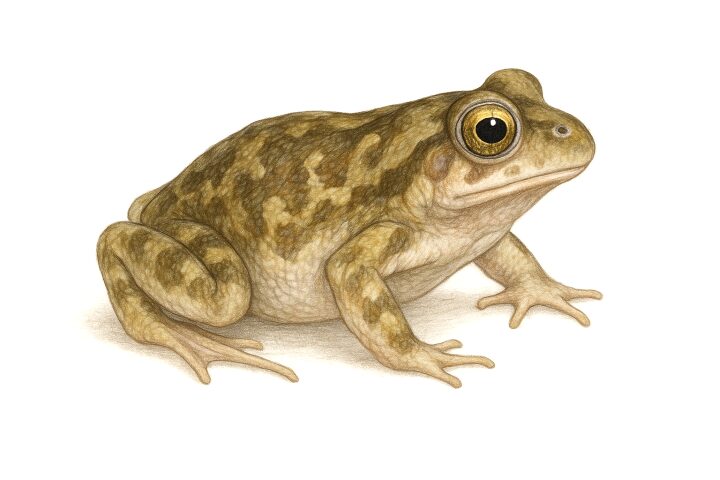
The Eastern Spadefoot is one of those amphibians that’s easy to overlook — until it’s not. These secretive little toads spend most of their lives hidden underground, popping up only under just the right conditions. What makes them stand out? For one, they’re built for digging, thanks to a unique, spade-like structure on their hind feet. And unlike most toads, they’ve got smooth, moist skin more like a frog’s. They’re quirky, rarely seen, and full of surprises.
Size & Physical Appearance
Eastern Spadefoots are on the smaller side, usually growing between 1.75 to 2.5 inches long. Their coloring is usually dark brown, olive, or gray, often with two yellowish or golden lines running down the back in a sort of lyre or hourglass shape. Some individuals lack this marking entirely, so coloration can be pretty variable.
Their eyes are particularly noticeable — large and bulging with vertical (cat-like) pupils. This is a rare trait in frogs and toads, and it’s a good clue you’re looking at a spadefoot. The name of the game with this species is subtlety — they don’t have the warty, bulky look of a true toad, and their skin is smoother than you might expect.
Males and females look pretty similar, but during breeding season, males may have darker throats and give off soft, sheep-like calls at night.
Habitat and Range
Eastern Spadefoots prefer sandy or loose soils that are easy to dig into, often in open woodlands, fields, pine barrens, or coastal plains. They’re especially tied to areas that experience occasional heavy rains and flooding — because they rely on temporary pools and vernal ponds to breed.
Geographically, they’re found throughout the southeastern United States, but their range does extend northward into parts of the Midwest and even up to southern New England. You’ll find them in states like Florida, Georgia, the Carolinas, Alabama, Mississippi, and parts of Tennessee, Kentucky, and Virginia — and as far up as Massachusetts and New York in small, scattered pockets.
They’re more common at lower elevations, usually below 1,500 feet.
Diet
In the wild, Eastern Spadefoots primarily eat insects and other small invertebrates. Think ants, beetles, spiders, crickets, and caterpillars. They’re opportunistic feeders, snapping up pretty much anything small enough to fit into their mouth.
Because they spend much of the year underground, they do most of their hunting during short above-ground periods — especially after heavy rains when prey is abundant.
Lifespan
In the wild, Eastern Spadefoots are believed to live around 5 to 10 years, though some have lived longer in captivity when kept under ideal conditions. Their underground lifestyle helps them avoid predators and extreme conditions, which may contribute to that longer life.
Identification Tips
Eastern Spadefoots can be tricky to ID because they don’t always fit our usual image of a frog or toad. Here’s what to look for:
- Vertical pupils — This is one of the biggest giveaways. Most frogs and toads in the U.S. have round or horizontal pupils.
- Smooth (but not slimy) skin — Unlike bumpy toads, these guys have relatively smooth skin but still look dry.
- Yellowish lines down the back — Often shaped like a lyre or keyhole, but not always present.
- Hind feet “spade” — On each back foot, look for a dark, hard, wedge-shaped bump. They use it like a little shovel to dig backward into the soil.
Spadefoots are sometimes confused with true toads (like Fowler’s Toad or American Toad), but those species have more warty skin, horizontal pupils, and visible parotoid glands (those large bumps behind the eyes that secrete toxins). Eastern Spadefoots don’t have those glands and tend to be more slender overall.
Fun Fact
During dry spells, Eastern Spadefoots can stay hidden underground for months — even years — at a time. What brings them to the surface? A heavy rainstorm. When conditions are right, entire underground populations will emerge, breed in a frenzy, and lay eggs in shallow pools that may only last a few days. Their tadpoles grow at record speed, often metamorphosing in just 10 to 14 days. That adaptability is pretty amazing.
Despite being so elusive, Eastern Spadefoots play a cool role in their ecosystems. If you’re lucky (and maybe a little damp), you might just hear or spot one during a rainy night in spring or summer. Just keep your ears open for their soft bleating call and watch for those flashing yellow eyes.