
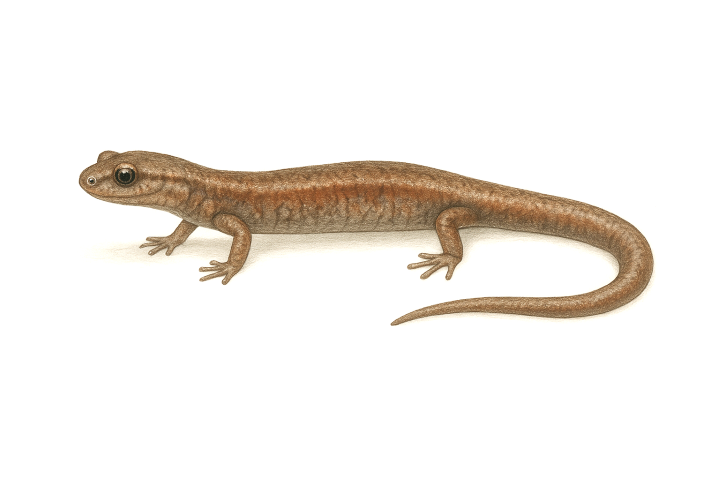
The Fairview Slender Salamander is one of nature’s small wonders — rarely seen, even though it lives right under our feet. Native to a tiny patch of Southern California, this salamander is a master of survival in a very small neighborhood. With its noodle-thin body and hidden lifestyle, it’s a great example of how much biodiversity is quietly thriving in places we might not expect.
Size & Physical Appearance
This is a pretty petite salamander. Adults usually measure between 1.5 to 2.4 inches from snout to base of the tail, but their tails can be longer than their bodies, giving them an overall length closer to 4 to 5 inches.
They have a long, slender body with four tiny legs and toes that look almost too small to support them. Their skin is thin and moist, usually dark brown to black with a reddish or coppery stripe running down the back. Some individuals have faint specks or mottling along the sides.
Males and females look pretty similar, though males may have slightly broader heads during the breeding season. Juveniles are less colorful and often have shiny black bodies with a less noticeable dorsal stripe.
Habitat and Range
This species has an incredibly limited range — it’s only known from a small part of the eastern San Jacinto Mountains in Riverside County, California. That makes it what scientists call an endemic species, meaning it doesn’t live anywhere else on Earth.
Fairview Slender Salamanders prefer moist, shaded environments like oak woodlands, chaparral, and coniferous forests. They’re usually found at elevations between 3,500 and 6,000 feet. During the dry season, they retreat underground where it’s cooler and more humid.
Diet
These salamanders are insectivores, and they’re not picky eaters. They feed on tiny soil invertebrates like springtails, mites, ants, and small beetles. Basically, whatever fits in their mouth and wiggles.
They hunt mostly at night or during wet conditions, using their sticky tongues to snatch prey.
Lifespan
In the wild, Fairview Slender Salamanders are believed to live around 5 to 10 years, though exact data is limited because they’re so secretive. In captivity, similar species have lived up to 10 or 11 years with proper care.
Identification Tips
This species can be tricky to identify, especially since there are other slender salamanders in California. Here are some tips:
- Size and shape: Narrow, worm-like body with very short limbs and a long tail.
- Color pattern: Look for a on a dark black or brown background.
- Location is key: They’re only found in a specific area of Riverside County, so if you’re outside the San Jacinto Mountains, it’s probably a different species.
Similar species include the Garden Slender Salamander (Batrachoseps major) and Santa Lucia Slender Salamander (Batrachoseps luciae), but those are found in other regions and often have subtle differences in color and body proportions.
Fun Fact
These salamanders don’t have lungs — they breathe entirely through their skin and the thin membranes in their mouths. That’s why it’s so important for them to stay moist. If their skin dries out, they can’t breathe. That’s also why you’re more likely to find them right after it rains.
Final Thoughts
The Fairview Slender Salamander is a reminder of the incredible things that can evolve in just the right microclimate. With their unique breathing system, tiny size, and super-limited range, they’re one of California’s many hidden gems.
If you’re lucky enough to spot one, enjoy it from a distance — and always leave logs, rocks, and leaf litter just the way you found them. These fragile habitats are easy to disturb, and these small creatures depend on them for survival.