
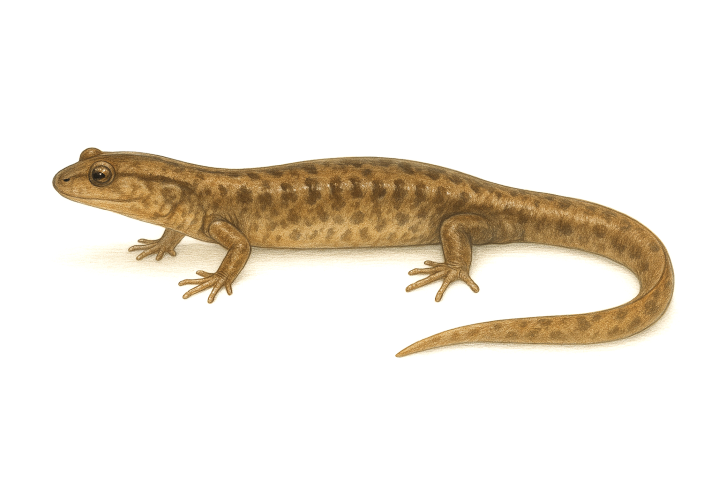
The Flat-headed Salamander is a little-known amphibian that’s as stealthy as it is specialized. Endemic to a small stretch of the Appalachian Mountains, this salamander isn’t one you’re likely to stumble upon unless you’re really looking. It’s known for its noticeably flat head and secretive lifestyle, spending most of its time tucked away in seeps and springs deep in the forest. If you love discovering wildlife that flies under the radar, this is a fun one to know.
Size & Physical Appearance
This species is on the small side. Adults typically measure between 2.5 to 4 inches in total length. As the name suggests, its most distinctive feature is a broad, flat head—a trait that sets it apart from many other salamanders in its range.
Their color varies from dark brown to black, with some individuals showing subtle mottling or tiny flecks on their back. The belly is lighter, often peppered with pale specks. Juveniles tend to be more slender and may appear a bit more contrasting in color, but they still keep that signature flattened head shape.
Habitat and Range
The Flat-headed Salamander has a very limited range, found only in the highlands of southeast Kentucky and southwestern Virginia. It’s typically restricted to the Ridge and Valley region of the central Appalachian Mountains.
It lives in cool, moist forests—especially near seeps, springs, and small trickling streams where water is constant but not fast-flowing. These salamanders often hide under rocks, logs, or leaf litter, relying on the cool dampness to keep their skin moist. You’ll usually find them at elevations above 1,500 feet.
Diet
Like most salamanders, Flat-headed Salamanders are carnivores. Their diet includes small invertebrates like:
- Insects and insect larvae
- Spiders
- Worms
- Small crustaceans in wet areas
They hunt mostly at night, using their stealth to ambush prey in the moist leaf litter and around shallow water sources.
Lifespan
In the wild, the Flat-headed Salamander likely lives around 8 to 10 years, although detailed studies on its lifespan are limited. In captivity, where conditions are more stable, they could potentially live a bit longer, but they are not common in the pet trade.
Identification Tips
This is a salamander that requires a sharp eye to identify. Here’s how to spot one and tell it apart from others:
- Flat, broad head: This is the standout feature. If the head seems wider and flatter than the neck and body, you’re probably looking at a Flat-headed Salamander.
- No dorsolateral stripe: Unlike some similar species like the Northern Dusky Salamander, this species usually lacks any strong, conspicuous stripes or patterns along the sides.
- Chunky back legs: While not totally unique, they are more developed than the front legs and can help differentiate it from more gracile species.
If you’re comparing it to the Northern Dusky Salamander (Desmognathus fuscus), note that the Northerns typically have a keeled tail and more visible patterning. The Flat-headed tends to be darker and plainer.
Fun Fact
The Flat-headed Salamander is considered a relict species, meaning it’s a holdover from a much earlier time. Its specialized upland habitat and narrow range make it a kind of living time capsule for the southern Appalachians. It’s believed to be one of the most restricted-range salamanders in the eastern United States.
In Summary
The Flat-headed Salamander is a shy, small amphibian with a unique look and a fascinating ecological niche. Found only in a sliver of the Appalachians, it’s not just rare—it’s a great reminder of how diverse and specialized salamanders can be. If you’re lucky enough to explore its mountain habitat, tread softly—these little amphibians are part of a delicate ecosystem well worth preserving.