
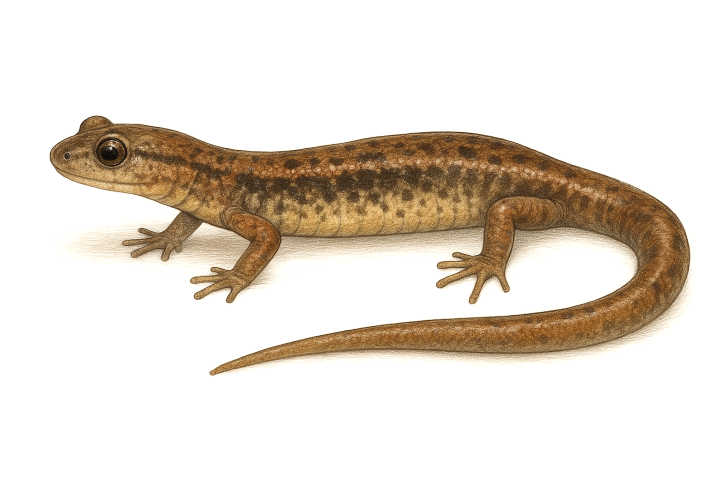
Tucked away in the Ouachita Mountains of Arkansas, the Fourche Mountain Salamander is one of those hidden gems that even seasoned hikers might walk right past without knowing it. This reclusive little amphibian is found nowhere else in the world — it’s what scientists call an endemic species. Its limited range and secretive lifestyle make it a special find for herp enthusiasts and conservationists alike.
Size & Physical Appearance
The Fourche Mountain Salamander is modest in size, usually measuring about 3.5 to 5 inches long from snout to tail. Its body is slender and smooth, with dark brown to black coloring. What really stands out is the fine pattern of light gray or silvery flecks scattered across its back and sides — almost like it’s been lightly sprinkled with powdered sugar.
Some individuals can have more visible flecking than others, and juveniles may be even darker in appearance. Males and females are generally similar in size and color, though males may show slightly swollen glands under the chin during breeding season.
Habitat and Range
This salamander is a true homebody. It’s found only in a small portion of the Ouachita Mountains in west-central Arkansas, specifically around the Fourche Mountain area — which is how it got its name.
It prefers cool, moist environments in upland forests with rocky outcrops. You’ll usually find it under leaf litter, moss, rotten logs, or beneath rocks. These salamanders are most active during cooler months or after a rain. In dry or hot weather, they retreat underground to avoid desiccation.
Their range is pretty restricted compared to other salamander species, and they typically live at moderate elevations between 1,000 and 2,500 feet.
Diet
Like most members of the lungless salamander family, the Fourche Mountain Salamander feeds on small invertebrates. That includes insects, spiders, snails, ants, and tiny worms. They’re nocturnal hunters, using their keen sense of smell and flicking tongue to snag prey in the leaf litter.
They don’t exactly have a fancy diet, but what’s interesting is how efficient they are at surviving in relatively nutrient-poor environments. Every little bug counts.
Lifespan
In the wild, these salamanders can live for at least 8 to 10 years, though precise data is limited due to their secretive nature. In captivity, related species have lived up to 15 years, so it’s possible they can match that under the right conditions.
Because they live in stable environments with relatively low predation pressure, they can enjoy fairly long lifespans — especially for something so small.
Identification Tips
The Fourche Mountain Salamander can be tricky to tell apart from a couple of close cousins in the same area, especially the Rich Mountain Salamander and Ouachita Dusky Salamander. Here’s how to spot the difference:
- Rich Mountain Salamander: Slightly larger and often has reddish tint or flecks rather than silvery. More restricted to Rich Mountain proper.
- Ouachita Dusky Salamander: Usually found closer to streams and has a more robust build, with a tail that’s more laterally compressed.
What sets the Fourche apart is its salt-and-pepper flecking pattern and its preference for drier, higher elevation forests — farther from water than most other salamanders.
Fun Fact
The Fourche Mountain Salamander breathes entirely through its skin — no lungs at all! This is why it needs to live in moist environments. Dry skin means no oxygen, so it depends on damp habitats to survive. That’s also part of the reason you won’t see it out and about in hot or dry weather.
Why It Matters
Because its range is so limited, the Fourche Mountain Salamander is considered a species of conservation concern. Habitat fragmentation, climate change, and deforestation all pose serious threats. If we lose even small chunks of the mountain forest ecosystem, it could have a big impact on this little salamander.
So if you’re hiking in the Ouachitas and stumble upon a shady, moss-covered rock — pause before flipping it over. And if you’re lucky enough to spot one of these elusive amphibians, take a moment to admire a species that exists nowhere else on Earth.
In Summary
The Fourche Mountain Salamander may not be flashy or loud, but it’s a fascinating piece of Arkansas’s natural heritage. For nature lovers, students, and outdoor explorers, it’s a reminder that sometimes the most extraordinary creatures are the ones hiding right under our feet.
Keep a sharp eye and a gentle touch — the forest is full of surprises.