
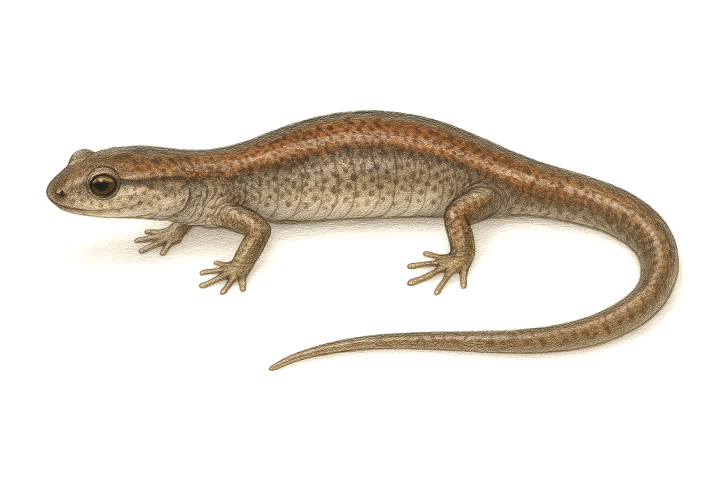
If you live in southern California and take a closer look under a log or some moist leaf litter, you just might spot a Garden Slender Salamander. This little amphibian is easy to miss — it’s incredibly small and spends most of its time hiding out of sight. But what it lacks in size, it makes up for in uniqueness. Known for its long body and teeny-tiny legs, the Garden Slender Salamander is one of the few salamanders in the U.S. that doesn’t rely on standing water to reproduce. That alone makes it pretty cool!
Size & Physical Appearance
The Garden Slender Salamander is, like its name suggests, seriously slender. Adults are typically between 1.5 to 2.7 inches long (that’s including the tail), although a big one might just hit 3 inches. The tail makes up roughly two-thirds of that length, so its body is very short compared to its entire size.
Their coloring can vary, but most individuals are dark brown to black with fine silvery, reddish, or brassy flecks down the back. You may also spot a faint reddish stripe along the spine. Their bellies are often a lighter gray, peppered with tiny white spots.
As for differences between males and females — there aren’t many that you’d notice without specialized equipment. Juveniles basically look like tiny versions of the adults, though they might be a bit more translucent when first emerging from the egg.
Habitat and Range
The Garden Slender Salamander is a California native, mostly found in coastal southern California and parts of northern Baja California, Mexico. Cities like San Diego, Los Angeles, and surrounding semi-urban areas are all within this species’ range.
Despite often being called a garden salamander, they’re not limited to backyards. This species prefers moist microhabitats within oak woodlands, chaparral, coastal sage scrub, and shaded gardens. You’ll typically find them under rocks, woodpiles, bark, or thick leaf litter. They need moisture to keep their skin from drying out, especially since they breathe through it (more on that below).
Unlike many other amphibians, they don’t need ponds or streams to reproduce — so don’t be surprised if you find them in areas without any standing water. This adaptability helps them thrive in semi-urban settings, provided there’s enough shade and moisture.
Diet
These little salamanders are opportunistic eaters. In the wild, they munch on a variety of small invertebrates — mostly tiny insects, arachnids, springtails, mites, worms, and snails.
Because they’re nocturnal and hunt in moist conditions, they mostly rely on ambush tactics — hiding under debris or leaf litter and lunging at prey when it gets close. They snatch up food using a sticky tongue, kind of like a frog but on a much smaller scale.
Lifespan
In the wild, the Garden Slender Salamander can live 5 to 10 years if conditions are right. Lifespans in captivity are not well documented, mainly because this species isn’t commonly kept as a pet. Plus, their specialized care needs (like high humidity and very specific temperatures) make them tough to maintain long-term in an artificial setting.
Identification Tips
At first glance, this salamander might look like a worm or baby snake — it’s that skinny. But here’s how you can tell you’re looking at a Garden Slender Salamander:
- Look for tiny legs — they have only four toes on each foot (most salamanders have five).
- Very elongated and narrow body — almost rope-like in appearance.
- Color pattern — typically dark with speckled or lightly striped backs.
These features help differentiate it from more robust salamanders like the Arboreal Salamander or the Western Red-backed Salamander. Also, unlike some other species, this one doesn’t have a larval (aquatic) stage — they hatch as miniature adults.
Fun Fact
The Garden Slender Salamander is part of a group known as lungless salamanders (family Plethodontidae). That means they breathe entirely through their skin and the lining of their mouth — no lungs at all! That’s why they need consistently moist environments to survive. If their skin dries out, they can’t breathe.
And here’s another neat trick: if attacked, they can drop their tail to distract predators and slither away — and yes, they can regrow it over time. Nature gave them a pretty handy escape plan.
Got a shady backyard with some garden mulch or logs? You may have a tiny wild neighbor in the form of a Garden Slender Salamander. Just be gentle — they’re harmless, delicate, and play a helpful role in keeping pest bugs in check.
Let us know if you’ve ever seen one in your neighborhood!