
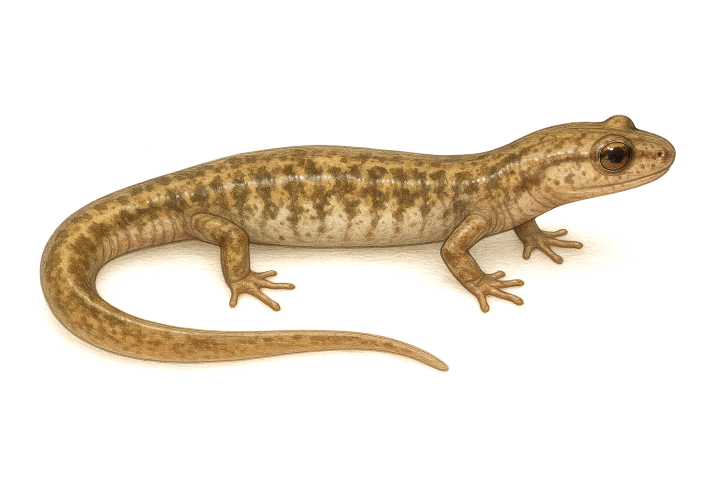
Hidden away in the springs of central Texas, the Georgetown Salamander is easy to miss — but it’s also incredibly special. This small, secretive amphibian lives its entire life underwater and is found in just a handful of spots near the city of Georgetown. Because of its tiny range and sensitivity to water quality, it’s become a symbol of the delicate balance between nature and development in the Texas Hill Country.
Size & Physical Appearance
The Georgetown Salamander is a petite, slender species that usually measures between 1.5 to 2.5 inches in total length. Its body is a muted yellowish or light brown, often with faint dark specks or mottling along the back. These spots help it blend into the rocky streambeds and spring outflows it calls home.
This salamander is part of a group known as neotenic species — meaning they retain their larval features for life. That means adults still have external gills, which look like feathery red tufts behind the head. These gills are not only distinctive but super useful in their oxygen-rich aquatic habitat.
There isn’t much noticeable difference between males and females, at least not without a close and careful look. Juveniles look like smaller versions of the adults, and because they don’t undergo metamorphosis, they keep their gills throughout their lives.
Habitat and Range
The Georgetown Salamander is an aquatic cave and spring specialist, and it’s only found in a small area of Williamson County, Texas. This species lives in cool, clear-water springs, spring-fed creeks, and the saturated rock of the Edwards Aquifer.
They prefer areas with limestone outcrops, flowing water, and shaded environments that help keep the water temperature stable — usually under 75 degrees Fahrenheit. Elevation-wise, they’re typically found between 700 to 1000 feet above sea level.
Because they depend on groundwater flow, the quality of that water — and how much there is — really matters. That’s why urban development and groundwater extraction in the area are major concerns for their survival.
Diet
The Georgetown Salamander feeds on tiny aquatic invertebrates. Their menu often includes small crustaceans, insect larvae (like mayflies and midges), and other microscopic critters that live in the gravel and flow zones of springs.
Since they’re underwater hunters, they rely heavily on their senses to find moving prey — that means detecting vibrations and chemical cues in the water rather than using sight alone.
Lifespan
In the wild, these salamanders are believed to live around 5 to 10 years, though exact data is hard to come by (they’re shy and hard to study). Lifespan in captivity hasn’t been studied extensively, but if the environment is similar — clean, cool, and stable — they likely do just as well.
Identification Tips
The Georgetown Salamander can be tricky to tell apart from other spring-dwelling Eurycea species in central Texas, such as the Jollyville Plateau Salamander or the Barton Springs Salamander. Here are a few things to look for:
- Location is key — if you’re in a spring or seep around Georgetown, this is your best bet.
- The Georgetown Salamander has shorter limbs and a stockier body than many of its close cousins.
- Look for the feathery external gills and lightly speckled coloring.
Honestly, even trained herpetologists sometimes need genetic tests to be 100 percent sure — these salamanders are that tricky!
Fun Fact
The Georgetown Salamander was once thought to be part of another species, but careful DNA testing revealed it was something new. Its scientific name, Eurycea naufragia, includes the word “naufragia” — Latin for shipwreck. That’s a nod to its isolated existence, like a castaway in its tiny habitat “islands” of springwater surrounded by land.
It’s one of the few amphibians truly at risk of disappearing simply because of where we build our cities and how we use water. In other words, keeping this little salamander around depends on how we treat the springs — and that makes it a pretty powerful ambassador for conservation!