
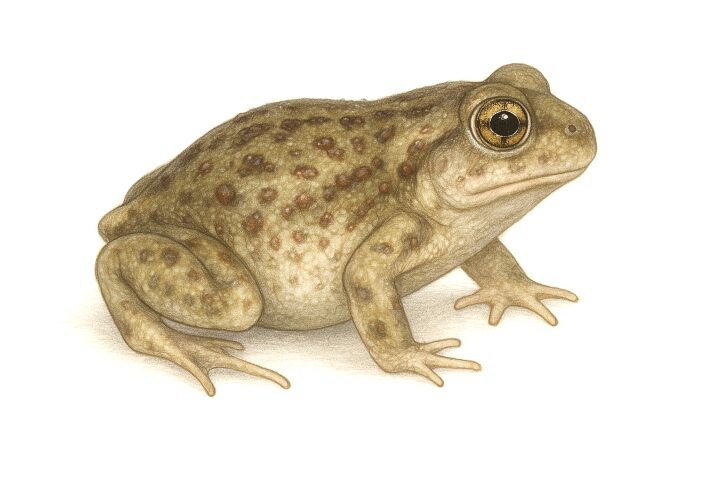
The Great Basin Spadefoot might not win any amphibian beauty contests, but it’s got some impressive skills. This little toad-like creature is built for life in dry places where most amphibians wouldn’t dare to live. Thanks to its special digging tools and amazing survival strategies, the Great Basin Spadefoot can spend most of its life underground — then suddenly appear after a rainstorm.
Size & Physical Appearance
Adult Great Basin Spadefoots usually measure between 1.5 to 2.5 inches in length, with females often being slightly larger than males.
They have a somewhat squat, rounded body with smooth, grayish to olive-colored skin and tiny dark spots across the back. A pale stripe often runs from the head down the back, but it’s not always obvious. One of their most distinctive features is the vertical pupil — unlike the rounded pupil you’d see in a typical frog.
And here’s the giveaway trait: on each hind foot, they have a hard, wedge-shaped “spade” used for digging. It’s dark and glossy and located on the heel. That spade is how they got their name — and how they escape the harsh environments they call home.
Habitat and Range
Despite being amphibians, Great Basin Spadefoots thrive in arid and semi-arid environments. They prefer sagebrush flats, deserts, grasslands, and open woodlands. You’ll often find them in areas with loose, sandy, or gravelly soil they can dig into, especially near seasonal ponds or temporary pools — places where rainwater collects for a short time.
They’re primarily found in the western United States, especially through the Great Basin region (hence the name). Their range includes parts of Oregon, Washington, Idaho, Nevada, Utah, California, and Colorado, and they’re most common at low to medium elevations — anywhere from sea level up to around 7,000 feet.
Diet
Great Basin Spadefoots aren’t picky eaters. Their diet mostly consists of small insects and invertebrates like:
- Ants
- Beetles
- Spiders
- Caterpillars
- Termites
They tend to be active at night and may use a sit-and-wait hunting strategy — basically hiding near a burrow and grabbing anything tasty that comes close.
Tadpoles are even more flexible. Depending on conditions, they may eat algae, detritus, or even other tadpoles. They’re opportunists, and it helps them grow fast during the short time water is available.
Lifespan
In the wild, Great Basin Spadefoots can live up to 10 years or more. That’s a surprisingly long life for such a small, fragile-looking amphibian. They spend most of that time burrowed underground, waiting for the right conditions to emerge and breed.
In captivity, data is limited, but they tend to be less common in the pet trade due to their specialized needs and protected status in some areas.
Identification Tips
This species is often mistaken for a true toad (like a Western Toad) but there are some key differences:
- Skin texture: Spadefoots have smoother skin, not warty like actual toads.
- Pupil shape: Vertical pupils, similar to a cat’s — most frogs and toads have round ones.
- Spade on the hind foot: A unique, black wedge on the sole that true toads don’t have.
- No prominent parotoid glands: Those large, raised glands behind the eyes (common in toads) are small or absent in spadefoots.
If you hear a strange duck-like quacking sound on a warm night after rain in the desert — it just might be a male Great Basin Spadefoot calling for a mate.
Fun Fact
When Great Basin Spadefoot tadpoles are faced with drying water, some of them transform into “cannibal morphs” — larger, more aggressive versions that eat their fellow tadpoles. This odd behavior helps them grow fast enough to metamorphose before their pond evaporates.
Pretty wild survival strategy, right?
Whether you’re a curious hiker in the desert or teaching kids about amphibians, the Great Basin Spadefoot is a memorable and resourceful little critter worth knowing.