
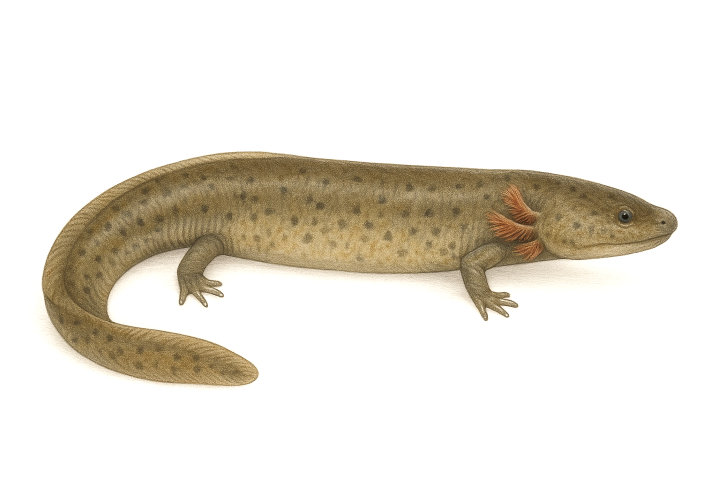
If you’re exploring swamps or slow-moving waters in the southeastern U.S., you might just run into something a bit unusual — a long, eel-like creature with feathery gills and tiny front legs. Meet the Greater Siren (Siren lacertina), one of the largest amphibians in North America. These secretive creatures are fully aquatic, meaning they never leave the water, and they look more like something out of a myth than a typical frog or salamander. With their snake-like bodies and permanent external gills, Greater Sirens are fascinating and full of surprises.
Size & Physical Appearance
Greater Sirens are big — really big. Adults can grow between 20 to 38 inches long, making them one of the longest amphibians in the U.S.
Their bodies are slender and eel-like, with smooth, slippery skin that’s usually a dark, olive green to grayish-black color. You’ll also notice they have prominent, bushy red or orange external gills on the sides of their head — a key feature. What makes them even more unusual is that they only have front legs — no hind legs at all.
Juveniles tend to be lighter in color and may have faint yellowish stripes down their bodies, which usually fade as they age. Males and females look pretty similar, although males tend to have slightly larger heads during breeding season.
Habitat and Range
Greater Sirens are highly aquatic and are almost never seen on land. They prefer slow-moving or still freshwater habitats such as swamps, marshes, ditches, ponds, and bayous. They usually hang out in spots with lots of vegetation like cattails, duckweed, or submerged plants, which give them both food and cover.
These sirens are found throughout the coastal southeastern United States, from eastern Virginia down through Florida, and west across southern Alabama and Mississippi. They’re often at low elevations but can be found as high as a few hundred feet above sea level, depending on local water availability.
Diet
Greater Sirens are opportunistic carnivores. That means they’ll eat just about anything small enough to fit in their mouths. Their diet includes:
- Insects (aquatic larvae, beetles, etc.)
- Snails and small crustaceans
- Worms
- Small fish and tadpoles
- Sometimes even plant matter
They primarily hunt at night, using their sensitive barbels (whisker-like structures near their mouths) to find food in murky water.
Lifespan
In the wild, Greater Sirens can live around 10 to 25 years, depending on environmental conditions and predation. In captivity, with good care, they’ve been known to live over 25 years, which is pretty impressive for an amphibian.
Identification Tips
Greater Sirens are unique, but there are a few other species they might be confused with:
- Lesser Siren (Siren intermedia): Much smaller (up to 27 inches), with more spots and darker coloration. Found farther west and slightly more widespread in the Midwest.
- Amphiumas: Long-bodied like sirens, but they have four very tiny legs (including hind legs), and their gills are internal (not the fluffy, external type). Amphiumas also have a different head shape, with more of a pointed snout.
The big giveaways for a Greater Siren: length over two feet, fluffy red external gills, no hind legs, and a smooth, eel-shaped body.
Fun Fact
When faced with drought or low water levels, Greater Sirens can actually aestivate — a kind of amphibian hibernation. They burrow into the mud and secrete a mucous cocoon around themselves to stay moist and wait out the dry spell. They can survive like this for months until the water returns!
If you’re lucky enough to spot a Greater Siren in the wild, enjoy the moment — these elusive giants are shy, and not many people get the chance to see one up close. Remember, they’re completely aquatic and play an important role in their wetland ecosystems, helping control insect and snail populations.
Whether you’re a curious student, a backyard naturalist, or just someone flipping over pond logs, the Greater Siren is a great reminder of how amazing and weirdly wonderful amphibians can be.