
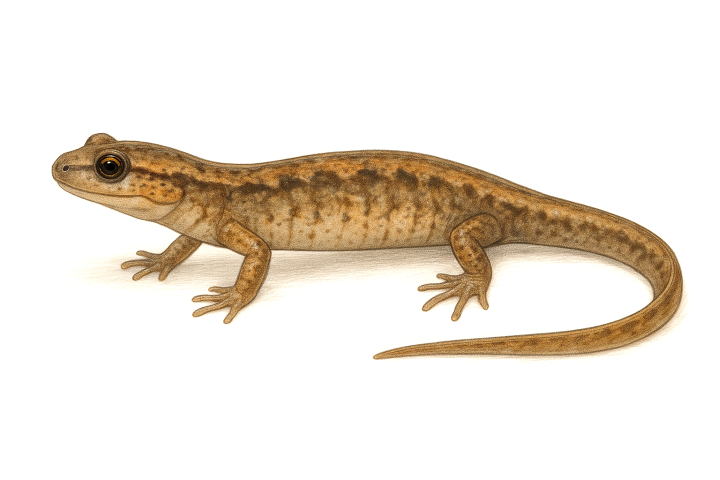
The Junaluska Salamander is a somewhat mysterious amphibian found only in a very small part of the United States. It’s known for being tough to spot, living much of its life in cold, clear mountain streams. With its slender build and well-camouflaged colors, this salamander is a master of blending into its rocky surroundings. If you’re lucky enough to come across one, you’re seeing one of the rarest stream salamanders in the eastern U.S.
Size & Physical Appearance
Junaluska Salamanders are medium-sized for a stream-dwelling species, usually measuring about 4 to 6.5 inches long. They have slender bodies with relatively short limbs and a long, thin tail that makes up about half their total length.
Their coloring is a blend of mottled or speckled browns, olives, and grays, which helps them blend perfectly with the stones and stream beds where they live. One of their key features is a dark line or stripe that runs from the eye down the side of the head. This marking is subtle but useful for identifying them.
Males and females look alike for most of the year, though during the breeding season, males may develop a slightly swollen vent area. Juveniles often look like small adults and can be hard to tell apart unless their size gives them away.
Habitat and Range
This species has an extremely limited range. Junaluska Salamanders are found only in a few stream systems in the southern Appalachian Mountains, primarily in western North Carolina and far eastern Tennessee. They favor fast-flowing, cool, clear mountain streams with rocky bottoms and plenty of places to hide, often at elevations between 2,500 and 4,000 feet.
Because of their sensitivity to water quality and habitat disturbance, they’re often used as bioindicators to help scientists monitor ecosystem health.
Diet
In the wild, Junaluska Salamanders are opportunistic carnivores. They feed mostly on small invertebrates like aquatic insects, worms, snails, and tiny crustaceans. Like many salamanders, they hunt by slowly creeping up on prey or lurking beneath rocks before quickly snapping them up with a swift movement.
Lifespan
Not much is known about the exact lifespan of the Junaluska Salamander in the wild, but many species in the same genus Eurycea can live for 5 to 10 years. Due to their reclusive nature and protected habitat, this salamander hasn’t been extensively studied in captivity.
Identification Tips
At first glance, you might confuse the Junaluska Salamander with other stream-dwelling species in the Southeast, like the Southern Two-lined Salamander (Eurycea cirrigera) or the Blue Ridge Two-lined Salamander (Eurycea wilderae).
Here are some ways to tell them apart:
- Duller color scheme: Junaluska Salamanders tend to have more muted colors compared to the bright yellow or orange tones of the Two-lined species.
- No distinct dorsal stripes: Unlike the clearly defined dark stripes on the sides of the Two-lined Salamanders, the Junaluska’s side stripe is more of a dusky blotch or line that’s harder to spot.
- Habitat specificity: Junaluska Salamanders are found mainly in high-elevation streams in western North Carolina and eastern Tennessee, while similar species have broader ranges.
Fun Fact
The Junaluska Salamander is named after a famous Cherokee leader, Chief Junaluska, who played a major role in early 19th century American history. It’s a fitting tribute, since this salamander is found in the same region where he once lived.
In Summary
The Junaluska Salamander is a rare Appalachian gem that thrives in the cool, glistening streams of the southern mountains. It’s elusive, beautifully camouflaged, and an important reminder of how many amphibians rely on clean, undisturbed habitats to survive. If you’re hiking in its home range, keep an eye on the rocks and streambanks — just remember to admire, not disturb, this special species.