
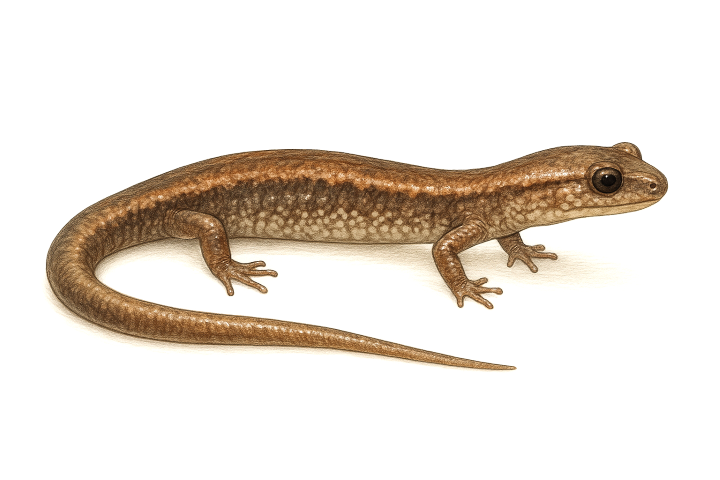
The Kern Canyon Slender Salamander is a rare little amphibian that calls the Sierra Nevada foothills of California home. It’s one of the lesser-known salamanders in the United States, but for folks who love unique species tucked away in hidden habitats, this one’s a gem. With its wormlike body and super tiny legs, it looks more like a woodland mystery than a typical salamander.
Size & Physical Appearance
This salamander is on the small side. Adults typically grow to about 1.5 to 2.3 inches (about 38 to 58 mm) from snout to vent — and if you count the tail, they can be nearly twice that length.
They have a narrow, elongated body with very short legs, which makes them look almost like a piece of licorice with toes. Their color is usually dark brown to nearly black, often with a lighter brown or reddish stripe running down the back. Some individuals might have faint light speckling along the sides.
There’s little visible difference between males and females, especially to the untrained eye. Juveniles look similar but may appear a bit more translucent or pale.
Habitat and Range
This species is a true local. The Kern Canyon Slender Salamander is found only in Kern County, California, specifically in and around the lower Kern River Canyon just east of Bakersfield.
They live in moist, rocky habitats — think shaded rock crevices, damp leaf litter, and areas beneath fallen logs. Most sightings come from oak woodlands and chaparral zones. Because they don’t tolerate dry conditions well, these salamanders stick to places where moisture lingers. Their range is tightly limited, and elevations where they’re found usually range from about 2,500 to 5,000 feet.
Diet
The Kern Canyon Slender Salamander has a tiny but active diet. It feeds mostly on small invertebrates that it finds in the leaf litter, such as:
- Springtails
- Termites
- Ants
- Tiny beetles
Because it’s a lungless salamander (more on that in a bit), it has to stay moist to breathe through its skin. That also ties into its feeding behavior — it’s usually out and about during damp conditions when both its body and its prey are active.
Lifespan
Exact data on how long the Kern Canyon Slender Salamander lives in the wild is limited — it’s a secretive species. But like other slender salamanders, they’re believed to live around 5 to 10 years in the wild. In captivity (in rare and scientifically managed situations), they might live a bit longer, assuming their moist environment needs are constantly met.
Identification Tips
This salamander can be tricky to spot and even trickier to identify, but there are a few clues:
- Very small and slender body — it almost looks wormlike.
- Tiny limbs with just 4 toes on each foot — which is fewer than most other U.S. salamanders.
- Dark brown to black color with a subtle dorsal stripe — often reddish or copper-toned.
- Unlike some other California salamanders, it lacks bright warning colors or bold patterns.
You might confuse it with other local slender salamander species (like Batrachoseps nigriventris), but the Kern Canyon Slender Salamander has a more restricted range. If you’re in its part of Kern County in moist rock or woodland areas, and you find one with a narrow body and short limbs, there’s a good chance you’re looking at B. simatus.
Fun Fact
The Kern Canyon Slender Salamander doesn’t have lungs — it “breathes” entirely through its skin and the lining of its mouth! That’s why it’s so tied to damp environments. If its skin dries out, it can’t breathe, which is kind of wild when you think about it.
Final Thoughts
Though it’s not a flashy amphibian, the Kern Canyon Slender Salamander is a great example of the unique biodiversity tucked into California’s lesser-known wild spaces. With its limited range and special habitat needs, it’s also a reminder of how important it is to protect even the most tucked-away corners of nature.
If you’re exploring the Kern River Canyon and flipping logs (carefully, and always putting them back), keep your eyes peeled for this little salamander. It’s proof that sometimes the most fascinating creatures are the ones you have to stop and look closely to find.