
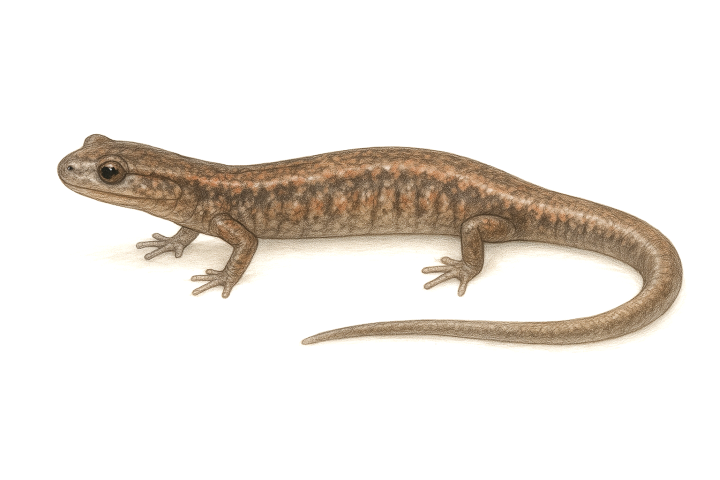
The Kings River Slender Salamander is one of those hidden gems of California amphibian life — small, secretive, and found only in a very specific part of the Sierra Nevada. If you’re lucky enough to spot one, take a moment to appreciate it. This rare little salamander has a tiny range and a fascinating lifestyle that keeps it mostly out of sight. But don’t let its size fool you — it’s an important part of its local ecosystem and a unique species in the world of American amphibians.
Size & Physical Appearance
Kings River Slender Salamanders are compact and… well, slender, as the name suggests. Adults typically measure between 1.5 to 2.2 inches long from snout to vent, with the tail adding even more length — sometimes longer than the body itself.
Their bodies are elongated and worm-like with short legs, which is common among Batrachoseps species. Their color usually ranges from dark brown to black, with a bronze or tan dorsal stripe that may be faint or more distinct depending on the individual. This stripe runs from the head down the back and can sometimes have tiny flecks or speckling. The belly tends to be lighter, often grayish or brownish with a somewhat translucent appearance.
Juveniles look similar to adults but are generally lighter in color and may have less defined markings. There’s no strong visual difference between males and females to the average observer.
Habitat and Range
This salamander has a very limited range. It’s only found in the upper Kings River watershed, primarily in Tulare County, California. That’s what makes it so special — you won’t find it anywhere outside of this small patch of the Sierra Nevada foothills.
It lives in moist, rocky woodlands and forested slopes, usually around elevations of 2,000 to 4,000 feet. They tend to stick close to creeks, springs, or north-facing slopes where moisture lasts longer through the dry California summers.
Look for them under rocks, logs, or leaf litter — especially after rains. They avoid light and dryness, so they’re most active on cool, damp nights or immediately following precipitation.
Diet
The Kings River Slender Salamander has a pretty standard diet for a woodland salamander. It feeds on small invertebrates like:
- Ants
- Termites
- Tiny beetles
- Mites
- Springtails
Because they’re so small, they go after the really tiny stuff — prey that can fit in their petite mouths. They rely heavily on stealth and their quick tongue to catch food.
Lifespan
In the wild, their average lifespan is believed to be around 5 to 10 years, though very few have been studied long-term. In captivity, if properly cared for (which is rare since they’re protected), they may live a bit longer. But this isn’t a salamander that you’ll commonly find in captivity or as part of the pet trade.
Identification Tips
It’s easy to confuse slender salamanders with other members of the Batrachoseps genus. There are over 20 different species that look similar at a glance. So how do you know if you’ve found the Kings River Slender Salamander?
- Location is key: Found only in a specific part of the Sierra Nevada — so identifying where you are helps narrow it down.
- Size and proportion: Very small body, very long tail (often longer than the body), and extremely narrow limbs.
- Dorsal stripe: Many nearby species lack the faint brown or bronze stripe that B. regius typically has.
- Toes: Like other slender salamanders, they have only four toes on each foot, which is different from many other salamander species in the region that have five.
If you’re still unsure, experts sometimes rely on genetic testing to distinguish these salamanders from their close relatives, because they really do look that much alike. But for most nature lovers, getting close enough to verify that it has four toes per foot is a solid clue you’re looking at one of the Batrachoseps family members.
Fun Fact
This salamander has no lungs — it breathes entirely through its skin! That’s why you’ll only find it in moist environments. If it dries out, it literally can’t breathe. Pretty wild, right? Think of the Kings River Slender Salamander as a little moisture-loving ninja that lives life under the radar — no lungs, small size, and a super niche habitat.
Bonus tip: If you’re hiking in the Sierra foothills during the rainy season, flip a log gently and you just might spot one. But always put logs and rocks back the way you found them — this helps protect fragile microhabitats.
Because of its tiny range and specialized needs, this salamander species is considered vulnerable to habitat changes and climate shifts. So if you do see one, consider it a rare treat — and leave it just the way you found it.