
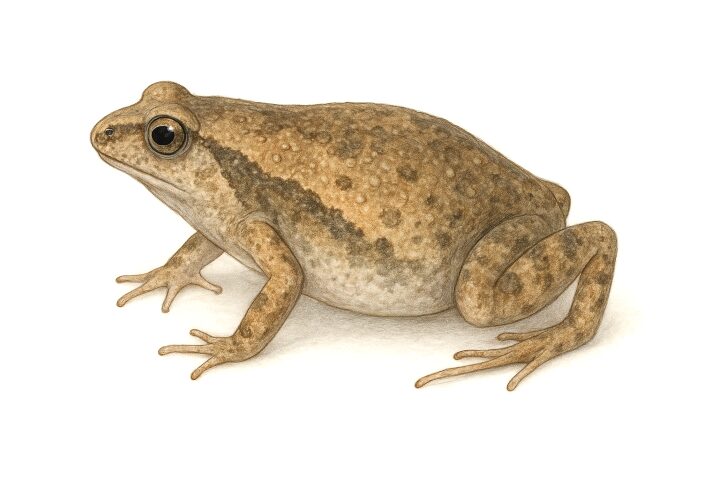
The Mazatlan Narrow-mouthed Toad might not look like your typical frog or toad — and that’s part of what makes it so fascinating. With its tiny size, smooth skin, and oddly shaped head, this secretive little amphibian is built for a hidden life underground. It’s a specialist in squeezing into tight places and snapping up ants, and while it’s named after a city in Mexico, its range stretches just into the very southern edge of the United States. If you’re lucky enough to spot one in Arizona, consider it a real treat.
Size & Physical Appearance
This toad is small — really small. Adults usually measure between 1 to 1.5 inches long (2.5 to 3.8 cm), which makes them easy to miss if you’re not looking closely.
Its body is squat and almost teardrop-shaped, with a narrow, pointed snout (hence the name). The skin is smooth rather than warty, and its color tends to be a mix of browns, grays, and sometimes olive green, often with darker flecks or blotches. The camouflage is excellent for blending in with leaf litter and soil.
There aren’t huge visible differences between males and females at a glance, though females tend to be slightly bigger. In breeding season, males may call near temporary pools, but they don’t get the swollen thumbs or large vocal sacs seen in other frog species.
Habitat and Range
The Mazatlan Narrow-mouthed Toad is primarily a Mexican species, but it just barely ventures into the United States — specifically in southern Arizona, including areas near the Sierra Madre Mountains.
It favors semi-arid scrublands, woodlands, and thorn forests, often at low to mid elevations. This species spends much of its life underground or hidden beneath rocks, logs, and leaf litter. It’s especially active during the summer monsoon season, when sudden rains create temporary pools for breeding.
Don’t expect to see them out on a casual walk; they are most active at night, and mostly during rainy periods.
Diet
Like other narrow-mouthed toads, this species is a specialist when it comes to food. It feeds mostly on small insects, with a strong preference for ants and termites. It has a narrow mouth that’s perfectly suited for slurping up these tiny insects, which can be hard to eat for other frogs and toads.
This diet also means they often hang out in spots with a good supply of ant colonies — not your average amphibian behavior.
Lifespan
In the wild, these toads probably live around 3 to 5 years, though exact data is limited due to how elusive they are. In captivity, they may live a bit longer, especially with steady care and feeding.
Identification Tips
Think you’ve spotted a Mazatlan Narrow-mouthed Toad? Here’s how to make a good guess:
- Size: Very small, only about an inch long.
- Shape: Teardrop-shaped body with a narrow, pointy snout.
- Skin: Smooth, not bumpy or warty like true toads.
- Color: Camouflaged brown or gray with darker flecks or patches.
- Behavior: Rarely seen unless it’s raining. Often stays hidden during dry conditions.
It’s easy to confuse them with other small narrow-mouthed toads, like the Eastern Narrow-mouthed Toad (Gastrophryne carolinensis), but that species doesn’t live this far west. The Great Plains Narrow-mouthed Toad (Gastrophryne olivacea) comes closer, but its range overlaps only slightly, and it’s more commonly found in Texas and surrounding states.
Fun Fact
These toads have a natural resistance to the painful chemicals that ants use to defend themselves. In fact, they’ve evolved to eat ants almost exclusively, which is pretty uncommon in amphibians. Their tiny, narrow mouths are specially adapted for this ant-based diet — think of them as the picky eaters of the toad world, with a taste for the spicy stuff most animals avoid.
If you’re hiking in Arizona and hear tiny, squeaky calls after a summer rainstorm, keep an eye on the ground. You might just spot one of North America’s stealthiest amphibians coming up from below to sing in the rain.