
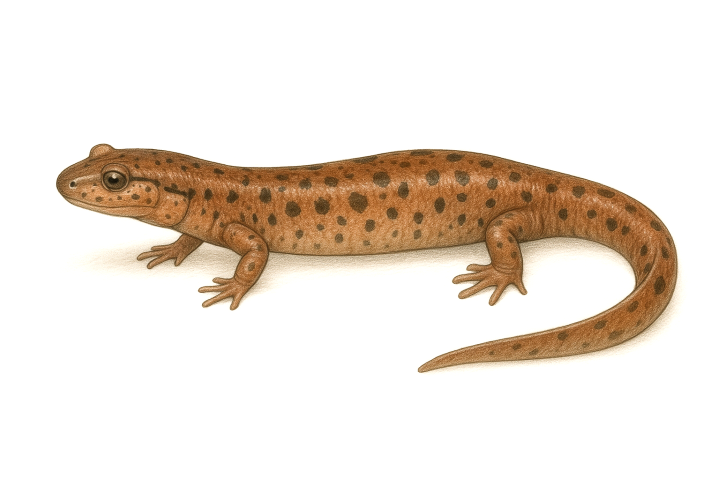
If you ever flip over a wet log in the southeastern woods and spot a chubby, reddish salamander with bright black spots staring back at you, chances are you’ve found a mud salamander. These secretive amphibians might not be the most famous salamanders out there, but they’re definitely one of the cutest—and they have some cool tricks up their sleeve, too. From their bold coloring to their surprising underground lifestyle, mud salamanders are a fascinating find for nature lovers of all ages.
Size & Physical Appearance
Mud salamanders are relatively stout compared to other slender species like the red-backed salamander. Adults are typically 3 to 6 inches long, though some can push closer to 7 inches. Their bodies are a color, often with irregular black or dark brown spots scattered across the back and sides.
Younger salamanders tend to be brighter red with more distinct spots. As they age, their color often darkens a bit, and their spots may become less pronounced—sometimes fading altogether in older individuals. Males and females are generally similar in appearance, though males may have slightly longer tails and more swollen cloacas during breeding season (details most people won’t notice in the field).
Habitat and Range
Mud salamanders love wet places—think muddy bottomlands, seeps, springs, and hillside trickles. They tend to live in areas with where they can burrow or hide under logs and rocks. They’re most active at night or after heavy rains.
In the U.S., their range spans much of the southeastern and eastern states, from southern New Jersey down through the Appalachian Mountains, and into parts of the Deep South. States like Georgia, South Carolina, North Carolina, Virginia, and Tennessee are known hotspots. They’re not as common as some other salamanders, so spotting one is a treat.
They’re typically found at elevations up to about 2,000 feet, though in some areas they may occur higher if suitable wet habitats exist.
Diet
Mud salamanders are —at least when it comes to tiny prey. They eat a variety of invertebrates, especially earthworms, small insects, spiders, and snails. Because they often hide during the day and hunt at night, most people never see them feeding.
One of their favorite snacks? (a fancy word for segmented worms), which are common in damp soil. Juveniles may go after smaller prey like springtails or tiny flies until they’re big enough to tackle something meatier.
Lifespan
In the wild, mud salamanders can live around , though exact data is limited due to their secretive nature. In captivity, with stable conditions and care, similar species have lived even longer—sometimes over .
Identification Tips
Mud salamanders are sometimes confused with two other species:
- – Looks very similar, but usually has a . Red salamanders also tend to have a more robust head and golden or yellowish eyes. Mud salamanders have .
- – These juveniles are bright orange-red and often roam the forest floor after rain. But unlike mud salamanders, red efts have dry, pebbly skin, lack dark spots on the back, and move with a less slinky gait.
If you’re trying to decide between a mud salamander and a red salamander, take a close look at the and the . Mud salamanders are a deeper, less flashy red with wider spacing between spots and dark eyes.
Fun Fact
Mud salamanders aren’t just named for where they live—they’re . These little guys can burrow several inches into soft mud, and will spend long periods underground, especially during dry or cold seasons. It’s one reason they’re so rarely seen despite not being especially rare in some areas!
In Summary
The mud salamander may not be the flashiest amphibian on the block, but its deep red color, burrowing lifestyle, and shy habits make it one of the more endearing and mysterious members of the salamander world. So the next time you’re walking near a wet woodland spring or streambank, keep your eyes peeled—there may be a mud-loving neighbor hiding just underfoot.