
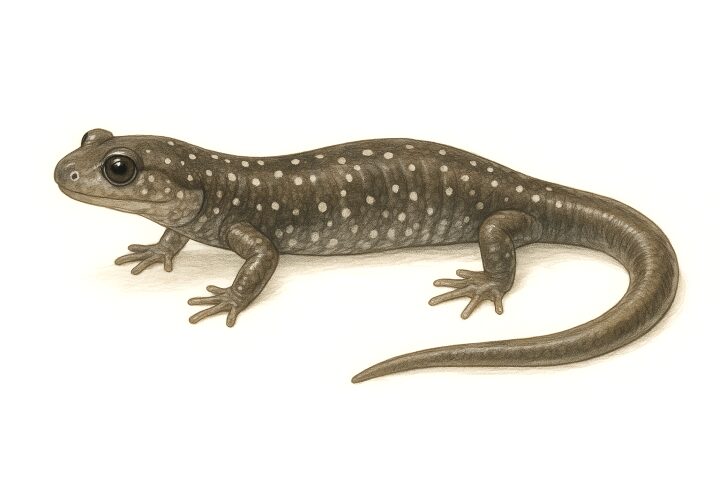
If you’re exploring the forests of central Georgia and happen to lift a log or turn over a rock, you might spot a shy little salamander that glistens like wet ink — that’s the Ocmulgee Slimy Salamander. Known for its sticky skin (which really lives up to the “slimy” name), this elusive amphibian is found nowhere else in the world. That’s right — it’s an endemic species only known from a relatively small area in Georgia. Its limited range and secretive lifestyle make it a fascinating find for salamander lovers and backyard nature explorers alike.
Size & Physical Appearance
The Ocmulgee Slimy Salamander is a small to medium-sized, lungless salamander. Adults typically range from 4 to 6 inches in total length, including their tail.
They have a slick, dark black body that’s speckled generously with tiny white, silver, or even gold-like flecks. These spots are scattered across their back and sides, giving them a “starry sky” appearance that can really shine under a flashlight.
Males and females look pretty similar, though males may have slightly longer tails and broader heads during breeding season. Juveniles tend to be a bit more patterned or brighter in their spotting, which can fade slightly as they age.
Habitat and Range
This salamander has a very limited range. It’s currently known only from central Georgia, especially areas around the Ocmulgee River basin — hence the name. It prefers moist, deciduous forests with plenty of leaf litter, logs, and rocks to hide under. It tends to avoid open or dry areas.
Ocmulgee Slimy Salamanders are often found on hillsides, ravines, and stream valleys, particularly in forests that have been relatively undisturbed. They’re usually seen at lower elevations, but always tied to moist, shaded habitats.
Diet
These salamanders are nocturnal hunters. They’re not picky eaters, and their diet includes a variety of small invertebrates like:
- Ants
- Beetles
- Spiders
- Worms
- Springtails
They wait under cover during the day and come out at night to forage, especially after rain. Their sticky skin doesn’t just keep them moist — it may also help them grip slippery prey.
Lifespan
In the wild, most slimy salamanders live about 7 to 10 years, although some may live longer with good conditions. In captivity (for educational or research purposes), similar Plethodon salamanders have been known to live up to 15 years or more.
Identification Tips
There are many slimy salamanders in the southeastern U.S., and they all look a bit alike. So how can you tell the Ocmulgee Slimy Salamander from the rest?
Here are a few identification tips:
- The Ocmulgee Slimy Salamander has a dark black base color covered with fine white or silvery spots. The spotting is usually heaviest on the sides and less dense on the back.
- The location matters — if you’re in central Georgia in suitable forested habitat, especially near the Ocmulgee River, there’s a good chance it’s this species.
- It lacks the bold coloration or eye stripes seen in some look-alike species, like the Northern Slimy Salamander or Southern Two-lined Salamander.
- Unlike some stream salamanders, this one has no aquatic larval stage and is entirely terrestrial.
If you’re still unsure, herpetologists often use genetics or very specific range data to confirm species in this complex group.
Fun Fact
The name “slimy” isn’t just for fun — when threatened, this salamander secretes a thick, sticky mucus from its skin. It’s not just gross — it’s a defense mechanism that makes it incredibly hard for predators (or curious humans) to hold onto. This slime has even been known to gum up the mouth of a snake trying to eat it!
Be careful if you handle one — the slime can stick to your hands and your clothes! But ideally, just observe it gently and let it go about its business.
Helping the Ocmulgee Slimy Salamander
Because of its limited range and habitat needs, this species is considered a conservation concern. If you live in or visit central Georgia, you can help by:
- Leaving logs, rocks, and leaf litter undisturbed.
- Avoiding the use of pesticides or chemicals near forested areas.
- Supporting local conservation efforts that protect native forests and watersheds.
Every little bit helps when it comes to protecting rare species with such small home ranges.
Wrap-Up
The Ocmulgee Slimy Salamander may not be flashy, but it’s a real gem for those patient enough to explore Georgia’s forests. Its sticky skin, secretive habits, and tiny sparkle-like spots make it both memorable and mysterious. Whether you’re a nature enthusiast, a student looking for a cool research subject, or just a curious hiker, keep your eyes open — you never know what remarkable creatures live in your own backyard.