
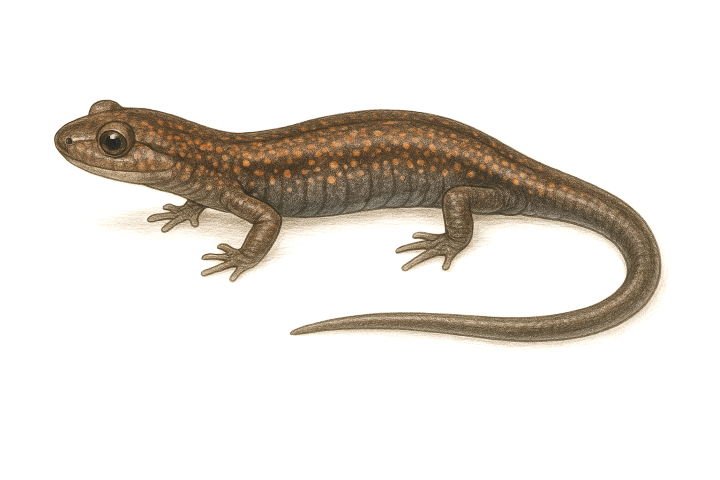
The Peaks of Otter Salamander (Plethodon hubrichti) is a rare, mountaintop-dwelling amphibian that’s found only in a very specific part of the Blue Ridge Mountains of Virginia. This species is a striking example of what biologists call an “endemic” animal — it doesn’t live anywhere else on Earth. Its incredibly narrow range and cool, moist habitat requirements make it both fascinating and vulnerable. If you’re hiking along the Blue Ridge Parkway near the Peaks of Otter, keep your eyes peeled — you might just spot this little Appalachian gem among the leaf litter.
Size & Physical Appearance
These salamanders are small and slender. Adults usually measure between 2.4 and 4.3 inches long, including the tail. Their color can vary quite a bit, which sometimes makes identification tricky. Most have a dark brown to black body with a scattering of brassy or bronze-colored flecks along the back and sides.
Some individuals have a faint dorsal stripe, while others are more uniformly dark. The underside (belly) is typically light gray. Juveniles tend to be darker and may lack the bronze flecking seen in adults.
There are no major differences between males and females that would be obvious to the casual observer without close inspection.
Habitat and Range
This salamander is a real homebody. It’s only found around the Peaks of Otter area in Bedford and Botetourt counties, Virginia, at elevations above roughly 2,500 feet. That makes it one of the most range-restricted amphibians in the United States.
It lives exclusively in cool, moist deciduous forests, especially hardwood forests dominated by oaks, maples, and beeches. These salamanders depend on thick leaf litter, mossy rocks, and decaying logs to stay moist and hidden during the day.
Because they don’t have lungs (they breathe through their skin and mouth lining), they’re highly sensitive to moisture. Hot, dry weather or deforestation can be dangerous for them.
Diet
Peaks of Otter Salamanders are nocturnal hunters. At night, they emerge from hiding to feed on a variety of small invertebrates like mites, springtails, ants, and tiny spiders.
They use a sticky tongue to catch prey (think of a frog, but on a much smaller scale). Their diet plays a role in keeping the soil and leaf litter ecosystem balanced.
Lifespan
In the wild, these salamanders are thought to live up to 10 years, though exact numbers are hard to confirm in such secretive animals. In captivity, their lifespan may be similar if their moisture and temperature needs are carefully maintained — but this species is not commonly kept or bred outside its natural habitat.
Identification Tips
The Peaks of Otter Salamander is closely related to the Eastern Red-backed Salamander (Plethodon cinereus), which overlaps slightly in range. However, there are a few ways to tell them apart:
- Color: Red-backed salamanders usually have a distinct red or orange stripe down their back. Peaks of Otter Salamanders generally do not.
- Size: Both species are small, but adult Peaks of Otter Salamanders are often a bit more slender and slightly darker overall.
- Range: If you’re in high elevations near the Peaks of Otter, you’re more likely to find P. hubrichti. Elsewhere, you’re likely looking at a different species.
Because they’re part of the same genus and look alike, identification can be tricky in areas where their ranges might meet. Scientists use genetics and subtle physical traits to confirm ID when necessary.
Fun Fact
The Peaks of Otter Salamander was unknown to science until 1951. Its discovery helped scientists understand how different species can evolve in isolation when populations become separated on mountaintops — similar to islands in the sky.
This salamander is such a homebody that even small changes to its forest can impact its survival. It’s now protected due to its limited range and sensitivity to habitat disturbance. In some ways, it’s like the amphibian version of a rare postage stamp — tiny, beautiful, and worth preserving.
Final Thoughts
The Peaks of Otter Salamander may be small, but it’s a big deal in the world of conservation biology. Its presence tells us a lot about the health of Virginia’s Appalachian forests.
If you’re out hiking in the Peaks of Otter area, take a moment to appreciate the damp logs, leaf litter, and quiet beauty of the woods — you’re in the rare home of a mountain-native salamander that lives nowhere else on Earth. Just remember to leave logs and rocks where you found them and enjoy observing from a distance.
This species is a great reminder that sometimes big stories come in small, slippery packages.