
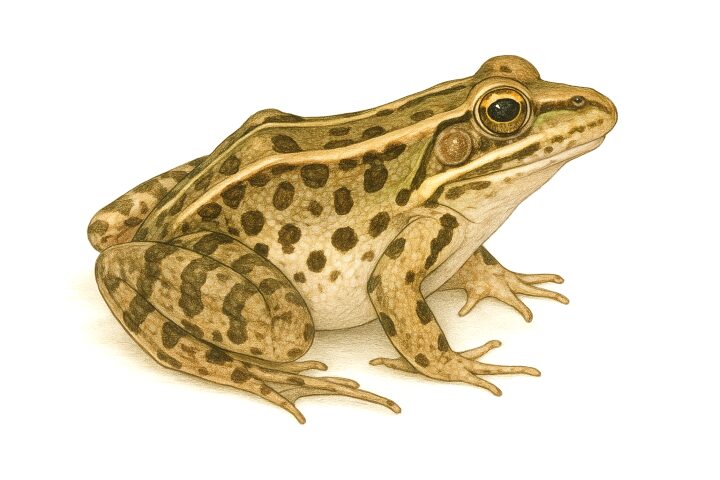
The Plains Leopard Frog is a fast-moving, spotted amphibian that calls the central United States home. It’s named for the bold, leopard-like spots on its back, which make it stand out from many of its more camouflaged cousins. These frogs are active, alert, and surprisingly good jumpers — often hopping into water before you even notice they were there.
Plains Leopard Frogs are part of the “true frog” family (Ranidae), and they’re considered a helpful species to have around because they love to eat insects. If you’re walking near a prairie pond or slow-moving stream and hear a low rattling call, you might just be near one of these fascinating frogs.
Size & Physical Appearance
Adult Plains Leopard Frogs are medium-sized, typically ranging from 2 to 4 inches long from nose to tailbone. Their backs are light brown to tan with distinctive dark brown spots scattered across them. These spots are often rounded and resemble the rosettes you’d see on a leopard’s coat, hence the name.
A key feature is the pair of light-colored dorsolateral folds (those ridges running down the back) that are usually broken toward the lower back — that break is one of the clues that helps identify them.
The underside is usually pale, and some individuals have a yellowish tinge on the groin or thighs. Males and females look similar, though males are often slightly smaller and may have darker pigmented thumb pads during breeding season.
Habitat and Range
Plains Leopard Frogs are found throughout much of the central U.S., particularly in states like Nebraska, Kansas, Oklahoma, Texas, New Mexico, Colorado, and South Dakota. They’re also spotted in parts of Missouri, Arkansas, and even into northern Mexico.
They prefer areas near permanent or seasonal water, especially in open prairie habitats. You’ll find them around ponds, marshes, streams, and cattle tanks, often where vegetation is sparse or patchy. Unlike some amphibians, these frogs can tolerate fairly dry conditions — as long as there’s water nearby for breeding.
They tend to live at lower to mid elevations, often below 6,000 feet.
Diet
In the wild, Plains Leopard Frogs eat a wide variety of insects and small invertebrates. Their menu might include crickets, beetles, flies, moths, spiders, and even smaller frogs on occasion.
They’re opportunistic feeders, meaning they’ll eat whatever they can catch and swallow — which is quite a bit, considering their quick tongues and fast reflexes. This diet also makes them great natural pest controllers, especially in agricultural areas.
Lifespan
In the wild, Plains Leopard Frogs typically live about 3 to 5 years. In captivity, under ideal care, they might live a bit longer, though they’re not commonly kept as pets.
Identification Tips
Plains Leopard Frogs are often confused with several other leopard frog species, especially the Northern and Southern Leopard Frogs. Here’s how to tell them apart:
- Broken dorsolateral folds: Look for the distinct light ridges along the back that break near the rear legs — this is a key feature of the Plains Leopard Frog.
- Spot patterns: The dark spots are usually more random and rounded compared to the more orderly spots on a Northern Leopard Frog.
- White spot under the eye: Often visible and can help distinguish it from some other frog species in its range.
It can take a practiced eye since variation exists, and even within the same pond, individuals can look slightly different.
Fun Fact
Here’s a weird but true tidbit — the Plains Leopard Frog is so skittish and fast that it’s earned a reputation among field biologists as one of the hardest leopard frogs to catch by hand. They prefer to jump into the water at the first hint of danger, and they can launch themselves surprisingly far to getaway. Think of them as the ninjas of the frog world.
Whether you’re out on a summer walk near a prairie pond or dipping your toes in a cow tank in the Texas panhandle, keep an eye (and ear) out for the Plains Leopard Frog. They’re a great reminder of how lively and diverse our amphibian neighbors can be — even in the open, drier parts of the country.