
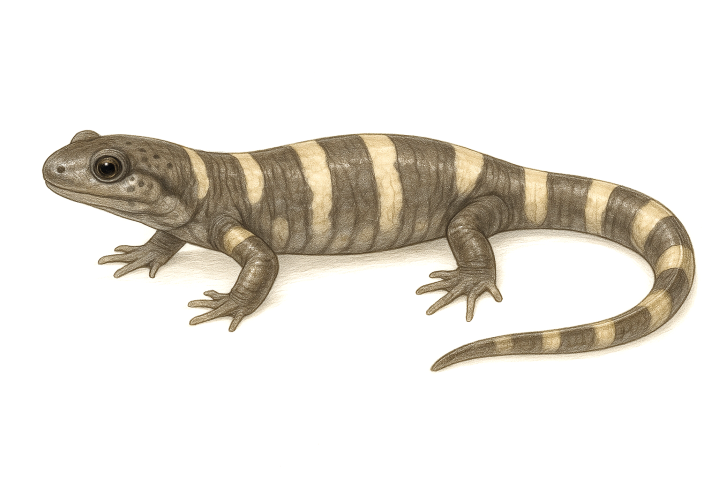
If you ever get the chance to spot a Ringed Salamander in the wild, count yourself lucky. This uncommon amphibian has bold yellow rings that make it look like something out of a cartoon — but it’s also secretive, spending most of its life hidden underground. Native to the Ozark and Ouachita Mountains, the Ringed Salamander is one of the more visually striking member of the mole salamander family. It’s a bit of a mystery even to scientists, which just adds to its charm.
Size & Physical Appearance
Adult Ringed Salamanders usually measure between 4 to 7 inches long, though some can grow a little larger.
They have smooth, dark gray or black skin with vivid yellow or white rings running across their bodies. These rings are what give the species its name — and they’re easiest to see on the back and tail. The belly tends to be lighter but still dark.
Males and females look pretty similar, but during breeding season, males develop a swollen cloaca and may appear a bit slimmer overall. Juveniles often look like mini adults, but their colors might be a little duller.
Habitat and Range
Ringed Salamanders are true forest dwellers. They prefer moist, deciduous woodlands, especially those with rocky outcrops, leaf litter, and nearby pools or ponds for breeding.
You’ll find them mainly in the central and southern United States — particularly in the Ozark Plateau and Ouachita Mountains of Missouri, Arkansas, and eastern Oklahoma. They’re local to those regions and tend to stay put.
During most of the year, they stay underground in burrows or under rocks and logs. They come out during cool, wet weather, especially in fall when it’s time to breed.
Diet
Like most mole salamanders, Ringed Salamanders are carnivorous. Their diet includes:
- Insects
- Worms
- Spiders
- Slugs and snails
- Other small invertebrates
They’re opportunistic feeders — basically, if something small moves near them, they’ll try to eat it. They hunt at night, usually by ambush.
Lifespan
In the wild, most Ringed Salamanders are believed to live around 5 to 10 years, although detailed studies are limited. In captivity, with proper care, they may live a bit longer, but they’re not commonly kept as pets.
Identification Tips
At first glance, you might confuse the Ringed Salamander with some other mole salamanders, like the Spotted Salamander (Ambystoma maculatum) or the Tiger Salamander (Ambystoma tigrinum). Here’s how to tell them apart:
- Ringed Salamanders have solid yellow or cream bands that wrap all the way around their bodies.
- Spotted Salamanders have bright yellow spots, but not full rings or bands.
- Tiger Salamanders have irregular patches or blotches, not neat, symmetrical bands.
Also, Ringed Salamanders have a relatively slim, elongated body and a more subdued, almost velvety look compared to the chunkier Tiger Salamander.
Fun Fact
Ringed Salamanders belong to a group known as “mole salamanders” because of their burrowing, underground lifestyle. They spend most of the year hidden beneath the forest floor and only come above ground to breed — usually during fall rains. This means many people live their whole lives in salamander territory and never see one!
Wrap-Up
The Ringed Salamander is one of those quiet, secretive species that reminds us just how much life is going on beneath our feet in the forest. Its bold colors and hidden habits make it a favorite among herping enthusiasts and a great subject for nature lovers hoping to learn more about the rich biodiversity of America’s woodlands.
If you’re out exploring the Ozarks or Ouachitas in the fall, keep an eye out — and maybe, if you’re lucky and patient, you’ll catch a glimpse of this beautiful, banded salamander.