
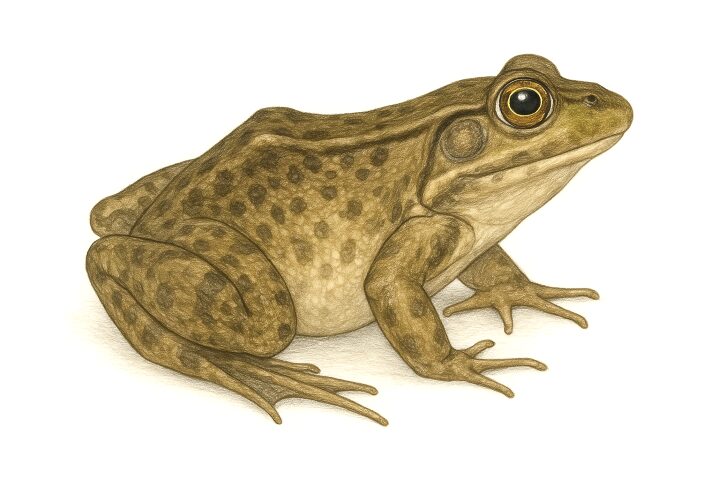
The River Frog is a stealthy, deep-voiced amphibian that’s easy to hear but surprisingly hard to spot. Found in the southeastern U.S., this large, dark-colored frog often lives near still waters like swamps and river floodplains. It’s known for its raspy call, powerful legs, and strange habit of “playing dead” when threatened. If you’re exploring wetlands in the South, you might be near a River Frog and not even know it.
Size & Physical Appearance
River Frogs are on the bigger side compared to most frogs in the U.S. They typically measure between 3.5 to 5 inches long (about 9 to 13 cm), though some get a little larger.
They’re mostly dark green to almost black with scattered light spots. A River Frog’s upper lip often has a pale outline, and its belly is usually a smeary, salt-and-pepper mix of gray and white. Juveniles tend to be more greenish with a clearer outline than adults.
Unlike some frogs, River Frogs don’t have bright colors on the inner thighs or groin area — which actually helps tell them apart from other species. Males are usually a bit smaller than females and may have darker throats.
Habitat and Range
You’ll mostly find River Frogs in the Southeastern United States, especially along the Coastal Plain. They have been recorded in states like Florida, Georgia, South Carolina, Alabama, Mississippi, and Louisiana, although populations have declined or disappeared in some places (like parts of South Carolina).
They prefer slow-moving or still freshwater environments — think swamps, bottomland forests, oxbow lakes, cypress ponds, and floodplain rivers. They hide in dense vegetation and hang out near the edges of water bodies. Elevation doesn’t play much of a role — they’re a lowland species.
Diet
These frogs are voracious, opportunistic feeders. They eat a wide range of prey, including insects, small crustaceans, spiders, and even other frogs (yes, sometimes even their own kind).
Their diet may also include small fish, tadpoles, and almost anything they can overpower and swallow. If it moves and fits in their mouth, it’s a potential meal.
Lifespan
In the wild, River Frogs likely live for about 4 to 6 years, though exact data is limited. In captivity, they might live slightly longer with proper care, but they’re not commonly kept as pets due to their specific habitat needs and declining numbers in some areas.
Identification Tips
Here’s how to tell a River Frog apart from lookalikes:
- No light-colored dorsolateral folds: Unlike the Green Frog or American Bullfrog, the River Frog lacks the pale ridges running along its back.
- Dark, dull coloration: While Bullfrogs are often a vibrant green or olive, River Frogs are darker — usually deep green, brown, or almost black.
- Light-edged lips: Look closely — they often have a pale, whitish outline on the upper lip.
- No bright inner thighs: Many frogs have yellow or reddish coloration here, but not the River Frog. It stays camouflaged even when jumping.
Also, listen for their distinctive call — it’s a deep, raspy “waaah” or grunting sound, kind of like a frog with laryngitis.
Fun Fact
River Frogs are masters of drama. When threatened, they have been seen going completely limp and playing dead — scientists actually describe this as “tonic immobility.” It’s a strange but effective trick to convince predators to move along.
Final Thoughts
Though fascinating and unique, the River Frog isn’t as easy to find as it used to be. Habitat loss and potential disease outbreaks have contributed to local declines in some areas, especially around the Carolinas. If you’re lucky enough to see one, be respectful and enjoy the quiet moment — you might just be in the presence of one of the more mysterious frogs in the Southeast.
Keep your eyes low and your ears open near swamps and rivers — and maybe bring a flashlight at night. That odd, raspy call in the dark? Could be a River Frog waiting just out of sight.