
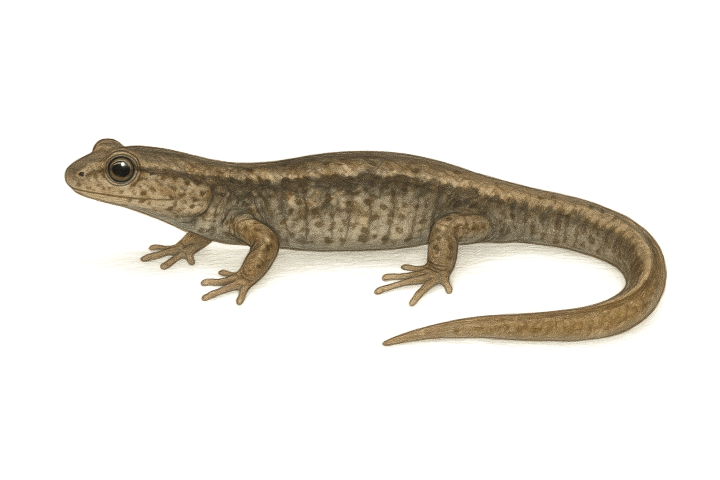
The Santeetlah Dusky Salamander is a secretive little amphibian that calls the southern Appalachian Mountains home. If you’ve never seen one, you’re not alone — these stream-loving salamanders are pretty sneaky and do a good job of blending into their surroundings. What makes them extra special? They’re found only in a small part of the world and are super sensitive to changes in their environment, making them an important indicator species for local ecosystem health.
Size & Physical Appearance
This salamander is fairly small, with adults ranging from about 2.5 to 4.5 inches in length, including the tail. Their coloring can be a mix of dark brown, gray, or black, often with light flecks or mottling on their back. Some individuals have faint traces of a lighter stripe down the spine, but this can be hard to see depending on the lighting and the salamander’s age.
Their skin is moist and smooth, with a sturdy body and long tail. Juveniles tend to have more contrast in their patterns, sometimes showing hints of bright coloring, but this fades as they mature. Males may develop slightly larger head muscles during the breeding season, but these differences can be pretty subtle.
Habitat and Range
The Santeetlah Dusky Salamander lives in cool, moist environments, especially near seeps, springs, and streams in mountainous areas. You’ll usually find them tucked under rocks or logs along streams in heavily forested areas.
This species has a very limited range, found mostly in parts of western North Carolina and adjacent Tennessee. Specifically, they’ve been observed in the Santeetlah Creek watershed — that’s where they get their name. They prefer mid- to high-elevation habitats, typically around 2,000 to 5,000 feet above sea level.
Diet
These salamanders are carnivorous and primarily eat small invertebrates like insects, spiders, worms, and tiny snails. They hunt at night and rely on their keen sense of smell and quick reflexes to snag tasty prey. Because they live near clean, flowing water, their diet reflects the rich insect life found in those areas.
Lifespan
In the wild, Santeetlah Dusky Salamanders can live for up to 10 to 15 years, although it’s hard to get exact numbers because they’re so elusive. There’s limited information about how they do in captivity since they’re not commonly kept or bred due to their highly specific habitat needs.
Identification Tips
These dusky salamanders are tricky to ID because they look a lot like other members of the Desmognathus genus.
Here’s how you can tell them apart:
- Tail shape: The Santeetlah Dusky Salamander has a tail that’s rounded in cross-section at the base — compare that to some similar species that have flatter tails adapted more for swimming.
- Location: One of your best clues is geography. If you’re in the Santeetlah Creek area or nearby, you’re more likely to encounter this species.
- Hind limb size: Like other dusky salamanders, they have hind legs that are stronger or bulkier than the front legs — a runner’s build instead of a swimmer’s.
They resemble the Southern Two-lined Salamander or other dusky cousins like the Seal Salamander, so habitat and careful observation are key for identification.
Fun Fact
You know they’re good at hiding — but did you know they breathe through their skin? Like many salamanders in their family, they don’t have lungs! Instead, they exchange oxygen through their moist skin and the lining of their mouth. That’s one reason why clean, damp environments are crucial for their survival.
Next time you’re hiking around a stream in the Southern Appalachians, take a moment to quietly turn over a rock (then gently put it back, of course!). With a little luck and a careful eye, you just might spot the camouflaged form of a Santeetlah Dusky Salamander holding perfectly still in its home beside the water.