
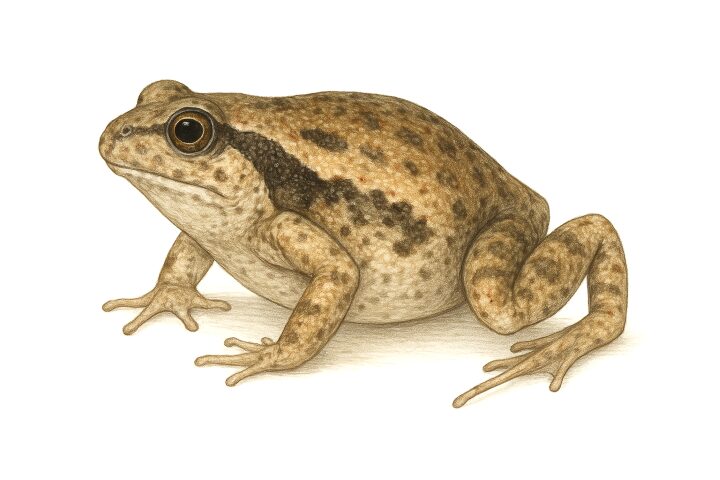
At first glance, the Sheep Frog (Hypopachus variolosus) might seem like just another small, brown frog. But once you hear it, you’ll understand why it gets such an unusual name. Its call sounds remarkably like a bleating sheep — an odd sound to hear coming from the ground near a pond or seasonal pool.
Found in parts of the southern U.S., this secretive little amphibian is better known for what it sounds like than what it looks like. It spends most of its life hidden underground and usually only emerges during rainy nights to sing, mate, and feed.
Size & Physical Appearance
Sheep Frogs are on the smaller side, usually measuring about 1.5 to 2 inches long.
They have a stout, rounded body with a slightly flattened head. Their skin is usually grayish brown or tan with faint darker mottling and a bumpy, warty texture — not unlike a toad. The belly tends to be pale or creamy, and some individuals have a narrow, lighter stripe down their back.
Males and females look fairly similar, but males have darker throats (used when calling), and their front legs are slightly stronger — helpful when it’s time to hold on to a mate.
Habitat and Range
In the United States, the Sheep Frog is mainly found in southern Texas, particularly in the Lower Rio Grande Valley, but its range stretches much farther south into Mexico and Central America.
This species loves warm, semi-arid to subtropical environments. You’ll usually find them in areas with sandy soils — grasslands, dry forests, or scrub brush — where they can burrow and stay hidden during the heat of the day. During the rainy season, they emerge from their underground hideouts to breed in temporary pools or roadside ditches.
Diet
Like many other small frogs, Sheep Frogs are mainly insectivores. They feed on ants, termites, beetles, and other small invertebrates they encounter near their burrows or during nocturnal outings. Their quick tongue and ambush-style hunting make them effective little bug-catchers.
What’s interesting is that their burrowing lifestyle means they often eat ground-dwelling insects and are likely to feed underground for much of the year when moisture levels are right.
Lifespan
In the wild, Sheep Frogs are not well-studied when it comes to longevity, but most small frogs like this can live about 4 to 8 years under the right conditions. In captivity, they might live a bit longer with consistent care and diet, though they’re not common in the pet trade.
Identification Tips
Sheep Frogs can be tricky to spot, especially since they spend so much time hidden. But if you hear what sounds like a nasal bleating “baaa” sound during the rainy season, there’s a good chance it’s this frog.
To tell them apart from similar species:
- Gulf Coast Toads are more common in Texas and are much larger, with a more flattened body and noticeable cranial ridges behind the eyes.
- Narrow-mouthed Toads (like Gastrophryne sp.) share the same general area and burrowing habits but tend to have a more pointed snout and smoother skin. Their call is more like a high-pitched buzz, not a bleat.
Look for stout-bodied frogs with rough skin and a sheep-like call. If you’re near south Texas after a rainstorm and hear something that sounds more farm animal than frog, you’ve probably found your answer.
Fun Fact
The Sheep Frog’s scientific name, Hypopachus variolosus, gives a clue to its skin texture — “variolosus” means “having small pits or marks,” which fits its warty skin nicely. But it’s the call that steals the show. Researchers and nature lovers alike have been caught off guard by hearing a “sheep bleat” in the middle of a puddle… then realizing it’s just this little amphibian showing off.
Whether you’re a curious student, a parent exploring local wildlife with your kids, or just someone who likes unexpected animal sounds, the Sheep Frog is a fun reminder that not every frog croaks. Sometimes, they baa.