
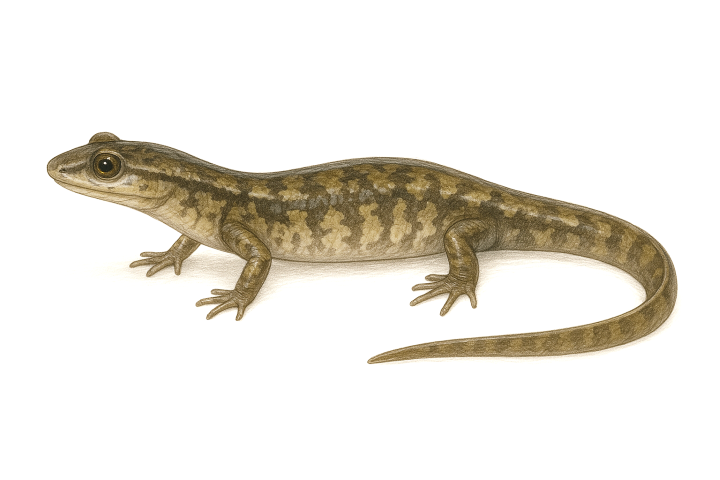
The Shovel-nosed Salamander is a sleek, stream-loving amphibian that’s made for life in fast-flowing mountain water. With its flattened snout and strong body, it’s uniquely built to handle rushing currents. Found in the southern Appalachian Mountains, this salamander is not just a master of stream life — it’s also a bit mysterious. Many people never spot one because it stays close to the streambed rocks, blending right in.
Size & Physical Appearance
Adult Shovel-nosed Salamanders usually measure between 3 to 5.5 inches long, including the tail. Their bodies are dark brown to blackish with slightly lighter marbled or speckled patterns along the sides. The tail is laterally compressed — almost fin-like — which helps with swimming.
One of the easiest ways to recognize them is that their heads are broad and flat with a snout that slopes downward — kind of like a little wedge. This “shovel-shaped” nose is where they get their common name.
There aren’t major physical differences between males and females, though males may be slightly larger during the breeding season. Juveniles look similar to adults but are generally lighter in color and may have more obvious markings.
Habitat and Range
Shovel-nosed Salamanders live in the fast, cold, and clear streams of the southern Appalachian Mountains, mainly in western North Carolina, eastern Tennessee, and northeastern Georgia. They’re stream specialists, usually sticking to higher elevation areas (above 2,000 feet) in heavily forested watersheds.
You’ll find them near riffles, under rocks, and along streambeds where the current is moving steadily — not the type of salamander you’d spot in a still pond or muddy ditch.
Diet
These salamanders are carnivores and feed on a variety of small aquatic invertebrates. Their diet mostly includes insects, insect larvae, small crustaceans, and worms that they find under rocks or drifting in the stream.
They’re ambush predators, often sitting motionless and striking when prey floats by — quick and stealthy.
Lifespan
In the wild, Shovel-nosed Salamanders are thought to live 5 to 8 years, though exact data is limited. In captivity, they may live slightly longer if kept in very specific, stream-like environments, but they aren’t commonly kept as pets. Their habitat needs are pretty tough to recreate.
Identification Tips
Because there are several similar-looking salamanders in their range, it’s easy to mix them up. Here’s how you can tell the Shovel-nosed Salamander apart:
- Flat, wedge-shaped snout: This is the big giveaway.
- Laterally compressed tail: Designed for swimming in current — think “paddle” more than “carrot.”
- Marbled or faintly mottled sides: Not as boldly patterned as some other Desmognathus species.
- Stream habitat: If you’re not near a cold, fast-moving creek, it’s probably not a Shovel-nose.
Don’t confuse this species with the Blackbelly Salamander (Desmognathus quadramaculatus), which is larger with a rounder snout and a more robust build. Likewise, the Seal Salamander (Desmognathus monticola) has a more curved jawline and tends to have a lighter mottled pattern.
Fun Fact
Despite spending most of their lives underwater, Shovel-nosed Salamanders actually breathe through their skin and the lining of their mouth. They have no lungs at all! Because of this, they need well-oxygenated water — another reason they’re only found in clean, cool mountain streams.
In Summary
The Shovel-nosed Salamander might not win any awards for flashiness, but it’s a fascinating example of nature adapting to a very specific environment. If you’re hiking in the southern Appalachians and stop by a fast-moving stream, take a little time to carefully look under flat rocks in shallow riffles. You just might spot one of these streamlined, stealthy salamanders clinging to the creek bottom — doing exactly what nature designed it to do.