
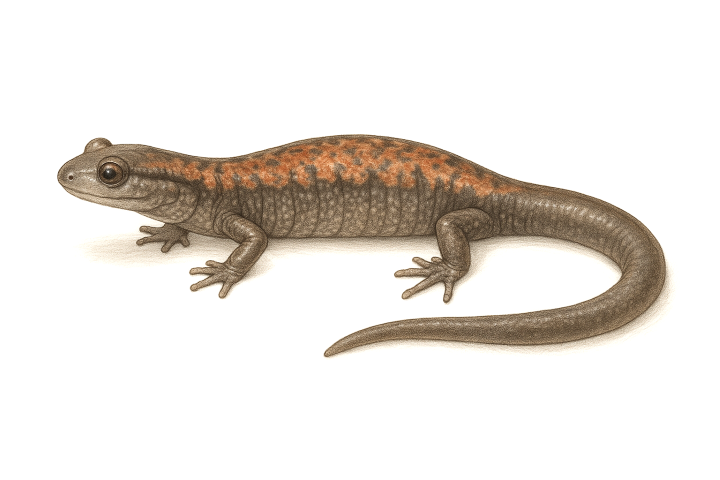
The Siskiyou Mountains Salamander is a small, elusive amphibian that’s native to a very specific slice of the Pacific Northwest. What makes this salamander special is its tiny range and its preference for cool, moist forests tucked into the rugged Siskiyou Mountains. It’s also completely lungless — like its relatives in the Plethodon genus — which means it breathes entirely through its skin. Not something you hear every day!
Size & Physical Appearance
The Siskiyou Mountains Salamander is on the smaller side, usually growing to about 3 to 5 inches in total length. Its slender body is dark brown or purplish with a sprinkling of fine white or coppery flecks along its back and sides. These flecks can make it look like its skin has a bit of sparkle to it when the light hits just right.
Males and females look pretty similar, especially to the untrained eye. Juveniles are typically darker and show less spotting, making them a little trickier to ID.
Habitat and Range
This species is found in a very limited area — mostly in the Siskiyou Mountains of southern Oregon and far northern California. It’s considered a habitat specialist and sticks to shady, rocky forests, often at elevations between 2,000 and 5,000 feet.
You’ll most likely find them under logs, within rock crevices, or hiding beneath leaf litter in moist, old-growth or late successional forests. They’re sensitive to changes in temperature and moisture, so they tend to avoid cleared or overly dry areas.
Diet
Like most woodland salamanders, the Siskiyou Mountains Salamander eats a diet of small invertebrates. That includes things like:
- Springtails
- Mites
- Ants
- Beetles
- Other tiny soil-dwelling critters
They’re sit-and-wait predators, which means they’ll hang out quietly until something tasty crawls within striking distance.
Lifespan
In the wild, the average Siskiyou Mountains Salamander can live at least 8 to 10 years, though some individuals may live longer under ideal conditions. Lifespan in captivity isn’t well documented, mostly because they’re not commonly kept or bred outside their native habitat due to conservation concerns.
Identification Tips
This salamander can be tough to tell apart from its close cousin, the Dunn’s Salamander (Plethodon dunni), especially since their ranges almost touch.
Here’s what to look for:
- Siskiyou Mountains Salamanders have a finer, more scattered pattern of light flecks over a dark body. The overall look is more speckled or dusted than striped.
- Dunn’s Salamanders tend to have a more obvious ochre or yellowish stripe down their back that straightens out toward the tail.
Also, the Siskiyou Mountains Salamander prefers higher elevation and rockier terrain, while Dunn’s may be found near streams in wetter, lower areas.
Fun Fact
Because this salamander breathes entirely through its skin, it must stay moist to survive — which means it almost never strays far from the cool, damp shelter of its forest home. Its dependency on such specific habitat conditions makes it highly sensitive to logging, road building, or even climate change.
In fact, scientists sometimes call it a climate canary — an early warning species for changes in forest ecosystems.
Conservation Note
The Siskiyou Mountains Salamander is considered a species of concern due to its restricted range and habitat threats. If you find one, it’s best to observe it gently and leave it undisturbed. Every individual matters when your entire species lives in such a small, fragile part of the world.
In Summary
The Siskiyou Mountains Salamander may not be the flashiest amphibian, but it’s a shining example of how diverse and specialized salamanders can be. From its speckled back to its lungless body, it’s a true forest dweller adapted to a very specific environment. Keep your eyes open next time you’re hiking through the shadowy, rock-covered slopes of the Siskiyous — you just might spot one hiding beneath a log.