
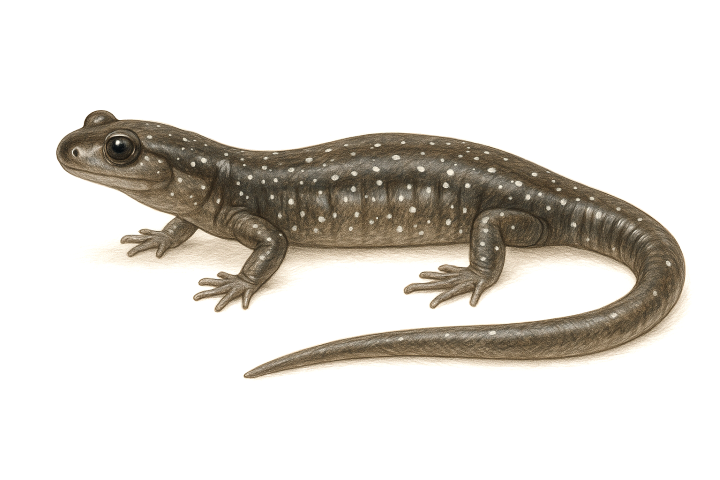
If you ever go hiking through the woods of the southeastern U.S., you might just spot the South Carolina slimy salamander — or more likely, you’ll hear about it before you see it. This elusive little amphibian is named for exactly what you’d expect: its super-slick, sticky skin. It’s part of a group known as woodland salamanders, which live entirely on land and breathe through their skin (yep, no lungs!). What really sets this species apart is how localized it is — it’s found in a pretty narrow strip of the southeastern coastal plain.
Size & Physical Appearance
South Carolina slimy salamanders are medium-sized, measuring around 4 to 6 inches long from snout to tail tip. They have jet-black bodies with light-colored speckles or spots, which can range from white to silvery. These speckles are usually most concentrated on the sides and limbs and tend to thin out across the back.
There’s not a dramatic difference between males and females in terms of color, but males might be slightly slimmer, especially around breeding season. Juveniles often look similar to adults but may have fewer spots and a more slender body.
Habitat and Range
This salamander is a bit of a homebody. It’s found primarily in the coastal plain regions of South Carolina, southeastern Georgia, and parts of northeast Florida. True to its name, it tends to stick to moist hardwood forests, thickets, and swampy woodlands.
They’re mostly active at night and spend the day hiding under logs, rocks, or leaf litter. Since they breathe through their skin, they stick to damp environments that help keep them from drying out. They’re generally found at low elevations, below 500 feet.
Diet
South Carolina slimy salamanders are stealthy hunters. They’re carnivorous and primarily eat small invertebrates like insects, spiders, worms, and slugs. They’re ambush predators, meaning they lie in wait and lunge at their prey when it gets close enough.
Something interesting: these salamanders use their sticky tongues to snag tiny prey, much like frogs do. That same sticky quality shows up in the gooey secretions they use for defense.
Lifespan
In the wild, these salamanders can live 8 to 10 years, though the exact lifespan isn’t well documented. In captivity (which is rare and not recommended without proper permits), they might live a little longer with stable conditions.
Identification Tips
At first glance, the South Carolina slimy salamander might be mistaken for other members of the Plethodon family (often called woodland or slimy salamanders), especially species like:
- Northern slimy salamander (Plethodon glutinosus): This one has more widespread white flecking across the back and is generally found farther north or west.
- Atlantic Coast slimy salamander (Plethodon chlorobryonis): Similar looking but tends to have more uniform spotting and a slightly different range (more coastal).
To tell them apart, look at spot patterns and the specific region you’re in. Plethodon variolatus often shows bold flecking on the limbs and sides, and its limited geographic range helps narrow it down.
Fun Fact
One of the coolest things about the South Carolina slimy salamander is its defense mechanism. When threatened, it secretes a sticky, glue-like substance from its skin. This goo can gum up predators — and even glue their jaws shut! Some people say it’s near impossible to get the stuff off your hands once it dries.
In Summary
The South Carolina slimy salamander might not be the flashiest amphibian, but it’s a fascinating little forest dweller with some serious survival tactics. Its localized range and simple yet striking appearance make it a unique find for nature lovers exploring the Southeast.
If you’re walking through damp woods in South Carolina or nearby areas, keep an eye out under logs or leaf litter — just be sure to put everything back how you found it. These salamanders depend on those microhabitats to stay safe and healthy.