
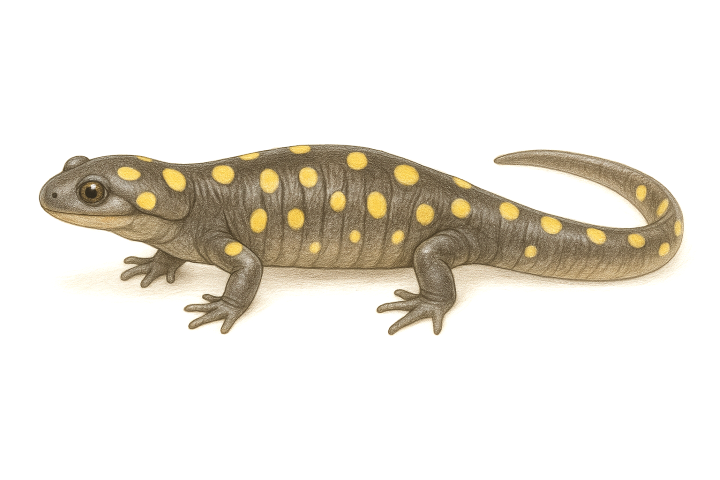
The Spotted Salamander is one of those creatures that feels like it belongs in a fairy tale. With its shiny black body and bright yellow or orange spots, it’s easy to see why this amphibian is a favorite among nature lovers and herp enthusiasts. Even though it’s striking to look at, the Spotted Salamander is pretty secretive and spends most of its life hidden underground. But during early spring rains, these salamanders emerge in groups to breed in vernal pools — a spectacle that’s become a seasonal highlight in many parts of the eastern U.S.
Size & Physical Appearance
Adult Spotted Salamanders usually grow to be about 6 to 9 inches long, though some individuals can reach up to 10 inches. They have a dark bluish-black or black body with two irregular rows of bright yellow or orange spots that run from the head down the back.
Males and females look pretty similar, but during the breeding season, males may appear slightly slimmer and more active. Juveniles hatch without spots but develop them as they grow.
Habitat and Range
Spotted Salamanders live in moist forests with plenty of leaf litter and cover like logs, rocks, or loose soil. They’re usually found near vernal (seasonal) pools, which are small, temporary wetlands that fill with water during the rainy season and dry up later in the year.
This species is widespread across the eastern United States and southeastern Canada. You can find them from parts of the Midwest all the way to the East Coast, including states like Ohio, Pennsylvania, Georgia, and as far north as Maine. They’re mostly found at lower elevations but can live in hilly or mountainous areas as long as forest and breeding habitat are available.
Diet
In the wild, Spotted Salamanders eat a diet of insects, worms, spiders, slugs, centipedes, and other small invertebrates. They’re not picky eaters — if something wiggly fits in their mouth and moves, they’ll probably try to eat it. At night, they come out of their hiding spots to hunt on the forest floor, using their sticky tongue to snatch prey.
Lifespan
In the wild, Spotted Salamanders can live up to 20 years, though the average lifespan is probably a bit less, depending on environmental conditions and predator threats. In captivity, with proper care, they may live even longer — sometimes up to 25 or 30 years.
Identification Tips
At first glance, some folks confuse the Spotted Salamander with other mole salamanders or even juvenile newts, but here’s what to look for:
- Bold yellow or orange spots running in two uneven rows down the back — no other salamander has quite the same pattern
- Thick body and wide head, with a smooth, moist skin
- Eastern Newts (juveniles especially) may be rusty or orange in color but don’t have those distinctive yellow spots
- Other mole salamanders like the Eastern Tiger Salamander are bulkier and have blotches instead of spots
Fun Fact
These salamanders have a seriously wild secret: their embryos form a symbiotic relationship with algae! The algae live inside the developing eggs and provide oxygen to the growing salamander larvae, while benefiting from the waste products the embryos produce. It’s the only known example of a vertebrate forming such an internal partnership with a plant!
So next time you’re out walking in the woods after a warm spring rain, keep an eye out near temporary pools and forest edges — you just might spot one of these stunning salamanders making its yearly appearance.