
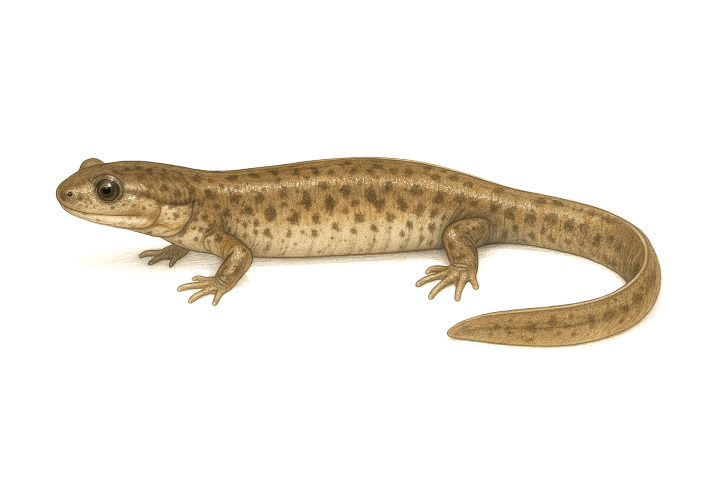
The Streamside Salamander is a bit of a hidden gem among North American amphibians. Unlike some of its flashier cousins, it keeps a low profile in forested valleys and stream banks. What makes it stand out? For one, it’s incredibly loyal to its streamside habitat (hence the name). It’s also one of the few mole salamanders that breeds mostly in small, clean, often fish-free streams — a rare trait in its genus.
Think of the Streamside Salamander as the quiet neighbor you rarely see, but who’s always been there — living under rocks, leaf litter, and logs, quietly doing its thing.
Size & Physical Appearance
Streamside Salamanders are medium-sized members of the mole salamander family.
- Adults typically measure between 4 to 7 inches in total length, including the tail.
- They have a stocky build, with a wide head and relatively short limbs.
- Their coloring is usually dark brown to black, sometimes with a purplish or gray tint, and scattered with small light flecks or spots on the back and sides.
- The underside is lighter, often gray or light brown.
There’s not a huge difference in coloration between males and females, though males in breeding condition may have slightly swollen cloacal regions. Juveniles look similar to adults but are smaller and sometimes a bit duller in color.
Habitat and Range
True to their name, Streamside Salamanders stick close to streams.
They live in wooded valleys, ravines, and hillsides where temporary or slow-moving, fish-free streams run through. Look for them in areas with plenty of leaf litter, rocks, and downed logs — the kind of natural cover they can hide under during the day.
Geographic range:
- They’re found mainly in the central and eastern United States.
- Populations are concentrated in parts of central Tennessee, northern Alabama, Kentucky, Ohio, and southeastern Indiana.
- They generally stay at low to mid elevations, especially in hilly or mountainous regions near flowing water.
In some places, their range overlaps with that of the closely related Small-mouthed Salamander, which can make ID a challenge (more on that below).
Diet
As larvae, Streamside Salamanders eat small aquatic invertebrates like insect larvae, tiny crustaceans, and even the occasional smaller tadpole.
Adults are carnivorous and tend to feed at night. Their diet includes:
- Earthworms
- Slugs and snails
- Insects like beetles and ants
- Occasionally small amphibians and other soft-bodied prey
They’re ambush predators, hiding under debris and waiting for a meal to scuttle by.
Lifespan
In the wild, Streamside Salamanders tend to live around 5 to 8 years, though some may live longer in ideal conditions. In captivity and under study, they’ve occasionally lived past 10.
Identification Tips
It’s easy to mistake a Streamside Salamander for its cousin, the Small-mouthed Salamander (Ambystoma texanum) — they look very similar and even hybridize in some places.
Here are some ways to tell them apart:
- Habitat: Streamside Salamanders are usually found near streams, whereas Small-mouthed Salamanders prefer ponds.
- Head shape: Streamside Salamanders tend to have a broader head and more rounded snout. Small-mouthed ones, as you might guess, have a narrower head and smaller mouth.
- Coloring: Both have mottled patterns, but Streamside Salamanders often have a darker, more uniform background color with fine light spotting.
- Behavior: Streamside Salamanders are often more secretive and less likely to be found far from their stream habitats.
During breeding season, locating the eggs can also help. Streamside Salamander eggs are attached singly or in small groups to the underside of submerged rocks in streams, often in cooler water than other mole salamanders prefer.
Fun Fact
Streamside Salamanders are loyal homebodies. Studies have shown that they return to the same breeding streams year after year — even if the stream is only a few inches wide. This homing instinct makes preserving their specific water sources critical, since they’re not great at adapting to new locations.
Wrap-Up
The Streamside Salamander might not win awards for flash or flair, but it plays a quiet, vital role in its ecosystem. By helping control insect populations and serving as both predator and prey, it’s an important part of the woodland stream community.
If you’re lucky enough to find one, remember that they’re shy and sensitive to disturbance. Take a good look, snap a photo if you want, and gently return any cover you move — they depend on that shelter to stay safe and moist. Happy herping!