
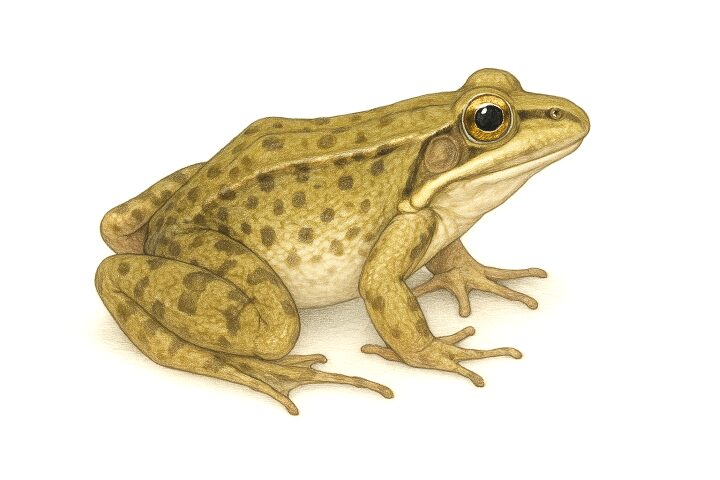
The Tarahumara Frog is a rare sight in the United States and has a story that surprises a lot of amphibian fans. It’s a true desert survivor, once native to parts of southern Arizona but now only found in the U.S. through reintroduction programs. Originally from Mexico’s Sierra Madre Occidental, this frog is known for its ability to survive in the rugged terrain of canyons and streams — far from the stereotypical swampy frog habitat.
Size & Physical Appearance
This is a medium to large frog. Adults usually range from 3 to 4.5 inches long (7.5 to 11.5 cm), with females typically being a little bigger than males.
Tarahumara Frogs have a brown to olive-green coloration on top, sometimes with a faint mottled or spotted pattern. Their undersides are usually pale, sometimes with a purplish or yellowish tint on the belly and throat. They don’t have the dramatic patterns or bright colors some frogs do, but their understated appearance helps them blend into rocky stream habitats.
Unlike many other North American frogs, the Tarahumara Frog has a relatively smooth back and long, powerful legs. Their eyes are large and sit high on the head, giving them excellent vision for spotting both predators and prey.
Habitat and Range
In the wild, these frogs live along permanent streams, springs, and rocky pools — ideally with clear, cool water and lots of cover. They are closely tied to riparian canyon habitats and are rarely (if ever) found far from water.
Historically, Tarahumara Frogs were found in southern Arizona, but they disappeared from the state in the 1980s due to habitat loss, disease, and possibly invasive species. Conservationists have since worked to reintroduce populations in southern Arizona, especially in protected mountain ranges like the Santa Rita Mountains. Their main range is still in northern Mexico, particularly in the Sierra Madre Occidental.
Elevation-wise, they’re typically found between 2,500 and 5,500 feet (760 to 1,675 meters).
Diet
Tarahumara Frogs are carnivorous and prefer a diet of small animals. Their wild menu includes:
- Insects like beetles, crickets, and flies
- Spiders and other small invertebrates
- Occasionally small frogs or tadpoles (even their own species)
They are ambush predators, waiting patiently for something edible to pass by before lunging with their quick tongues.
Lifespan
In the wild, these frogs probably live 4 to 8 years, though data is limited given how rare they are in the U.S. In managed or captive settings, they may live a little longer with proper care.
Identification Tips
Spotting a Tarahumara Frog in Arizona is a rare treat, but if you think you’ve found one, here are a few clues to help confirm:
- Size: Larger than most native Arizona frogs
- Color: Dull brown or olive green with minimal patterning
- No ridge: They lack the strong dorsolateral folds (the skin ridges along the back) seen in species like the Lowland Leopard Frog
- Smooth skin and long legs: Which help with both swimming and big jumps
If you’re comparing it to a similar species, you might confuse it with the Canyon Treefrog or Bullfrog. But Tarahumara Frogs are less bulky than Bullfrogs, and they don’t have the sticky toe pads or warty skin of a Canyon Treefrog.
Fun Fact
The Tarahumara Frog is probably the only frog in the United States that went extinct in the wild and got a second chance through reintroduction. This makes it an amphibian conservation success story — and a living symbol of how ecosystems can recover when people pitch in to help.
In Summary
The Tarahumara Frog isn’t the flashiest amphibian out there, but its resilience and comeback story are deeply inspiring. It’s a reminder that even desert canyons can host a secret world of amphibians — and that every species has a place in the wider puzzle of nature.
If you’re out hiking in southern Arizona and hear a low-pitched chucking call near a canyon stream, keep your eyes peeled — you might just be lucky enough to spot a Tarahumara Frog making its return.