
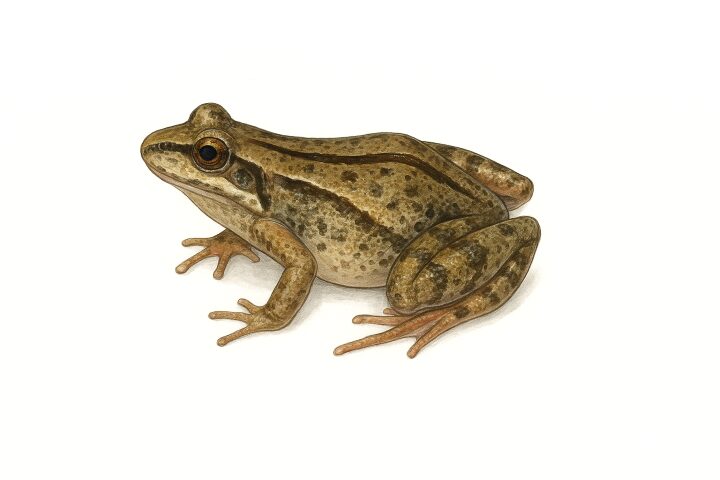
The Upland Chorus Frog may be tiny, but don’t let its size fool you. This little frog is one of the first to start calling in late winter or early spring, often while there’s still snow on the ground. Its distinctive call sounds a bit like someone running their fingers over the teeth of a comb — a cheerful, buzzy trill that signals the start of amphibian season in much of the southeastern United States.
Size & Physical Appearance
This frog is on the smaller side — adults typically measure between 0.75 to 1.5 inches long. They’re generally light brown to gray, sometimes greenish, with dark stripes or blotches across their back. Many individuals have a dark stripe running from their snout through the eye and continuing down the side of the body.
The belly is usually pale, and skin texture can be smooth or slightly warty. Males have darker throats during breeding season due to their vocal sac.
Juveniles tend to be paler with less distinct markings compared to adults, and females are usually slightly larger than males.
Habitat and Range
Upland Chorus Frogs are found throughout the southeastern and south-central United States, with their range stretching from New Jersey down through Florida, west into eastern Texas, and north into parts of the Midwest like Illinois and Indiana.
They’re incredibly adaptable frogs. You’ll find them in a variety of habitats including woodlands, grasslands, wetlands, and even suburban areas — especially in or near seasonal pools, wetlands, ditches, and flooded fields during the breeding season. They prefer lower elevations but can be found in the Piedmont and foothills in some areas.
In dry months, they stay hidden under leaf litter, logs, or in burrows to avoid drying out.
Diet
Despite their small size, Upland Chorus Frogs are active hunters. They mostly eat small insects, spiders, and other invertebrates like ants, beetles, and flies. Tadpoles feed on algae and organic matter in the water.
Their diet plays an important role in controlling insect populations — a bonus if you’re into mosquitoes not biting you.
Lifespan
In the wild, these frogs usually live around 1 to 3 years. That might not sound like much, but for a little frog that starts breeding as early as its first year, that’s a decent turn-around. In captivity, with proper care, they may live a bit longer, though they’re not commonly kept as pets.
Identification Tips
Because chorus frogs look a lot like each other, it can take a sharp eye (and ear) to tell them apart. Here’s how to spot an Upland Chorus Frog:
- Dark stripe down each side of the body, often from the snout through the eye to the groin.
- Three faint or broken stripes or spots down the back (though some may lack clear markings).
- Compared to the similar Spring Peeper (which has an X-shaped back mark), Upland Chorus Frogs lack the clean X.
- Their call is distinctive — a short, mechanical trill that sounds like drawing a finger over a fine-toothed comb (much more fluttery than a peeper’s peep).
You may also hear them before you see them — especially during breeding season, when males call from hidden spots near water.
Fun Fact
Upland Chorus Frogs can call while partially frozen or surrounded by icy water. They’ve evolved to take advantage of early breeding pools before predators like fish and bullfrogs move in — basically jumping the line in the amphibian world. Tough little frogs!
In Summary
The Upland Chorus Frog is a small but mighty voice in the springtime soundscape of the southeast. It’s a great example of how even the most modest-looking amphibians can have fascinating life strategies and surprising adaptations. If you’re out walking in February or March and hear that familiar trill, pause for a moment — you’re hearing one of nature’s early risers getting a jump on the season.