
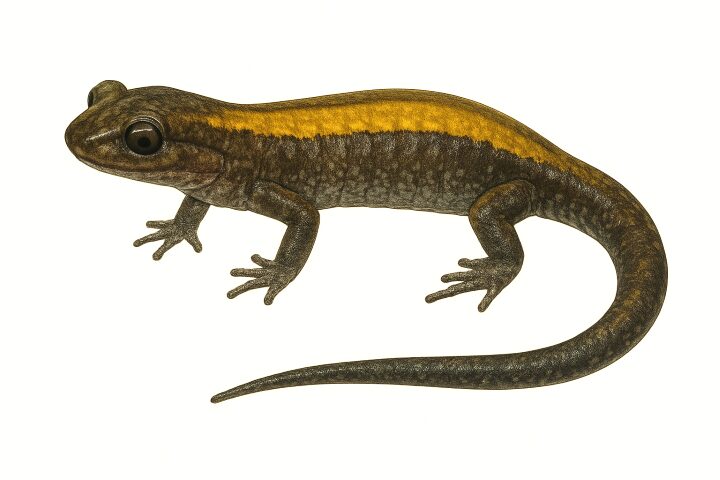
Van Dyke’s Salamander is one of those hidden gems of the amphibian world. Found only in a small part of the Pacific Northwest, it often flies under the radar because of its secretive lifestyle and limited range. But for those who know where to look, this slender, striking salamander offers a unique glimpse into the rich biodiversity of the region’s cool, damp forests. It’s a lungless salamander that relies entirely on its skin and mouth lining to breathe — an adaptation that ties it closely to moist habitats.
Size & Physical Appearance
Van Dyke’s Salamander is relatively small, usually measuring between 2.5 to 4 inches long, including the tail. It has a long, slim body with short limbs and a tail that nearly matches or exceeds its body length.
Its coloring can vary a bit but generally falls into two forms:
- Striped form: This version has a yellow, olive, or orangish dorsal stripe running from head to tail, bordered by darker sides.
- Unstriped form: This one lacks the stripe and is dark brown or black all over, often with faint flecking.
The belly is dark with some light mottling, and the legs often have a mottled or somewhat translucent look. Males and females look similar, though males may have more swollen glands around the jaw (mental glands), especially during breeding season.
Habitat and Range
This salamander is a Pacific Northwest specialist. It’s found in a narrow part of western Washington, particularly on the Olympic Peninsula and in the southern Cascade Mountains. One isolated population also exists in northern Idaho, which is recognized as a separate subspecies.
Van Dyke’s Salamanders prefer cool, moist forests, especially old-growth or mature second-growth forests. They’re most often found in rocky stream edges, under logs, or nestled in moss and moist talus slopes. Though many salamanders stick close to water, this species can often be found in relatively dry terrestrial habitats as long as the microclimate stays humid.
They’re typically spotted at low to mid elevations, up to about 4,000 feet.
Diet
Van Dyke’s Salamanders are carnivorous and primarily feed on small invertebrates like:
- Springtails
- Ants
- Beetles
- Small spiders
- Other soft-bodied insects
They hunt at night or during moist conditions, using their sticky tongues to snag prey. It’s a dynamic, insect-control role they play in the forest ecosystem — one you might not expect from something so small.
Lifespan
In the wild, Van Dyke’s Salamanders can live around 8 to 10 years, though exact data is limited since they’re so secretive. In captivity, lifespans may be a little longer with consistent conditions, sometimes up to 12 years. However, this species is rarely kept in captivity due to its specific habitat needs and protected status in some areas.
Identification Tips
Van Dyke’s Salamander can be tricky to identify because it looks a lot like a few other local species. Two you might confuse it with are the Western Red-backed Salamander (Plethodon vehiculum) and the Larch Mountain Salamander (Plethodon larselli).
Here are a few ways to tell them apart:
- Van Dyke’s Salamanders tend to have relatively short limbs and long bodies. Their stripe (if present) is usually less vivid than the bright red of the Western Red-backed Salamander.
- Larch Mountain Salamanders are smaller overall and usually found in a more limited range within the Cascades.
- If the salamander has a yellowish or olive dorsal stripe on a dark body, it might be Van Dyke’s — but check the toe length. Van Dyke’s usually has shorter toes compared to others.
Also, remember their preferred habitat — if you’re in the Olympics or southern Cascades under a mossy log in an old-growth forest, you’re in the right spot.
Fun Fact
Van Dyke’s Salamanders don’t need lungs — seriously. Like other members of the Plethodon group (also known as lungless salamanders), they get all their oxygen through their moist skin and the lining of their mouth. This unique feature means they must stay in damp environments to survive, but it also gives them a kind of built-in snorkel system for life among the moss and leaf litter.
In Summary
Van Dyke’s Salamander may not be flashy, but it’s a fascinating piece of the Pacific Northwest ecosystem. If you’re lucky enough to spot one, remember you’re seeing a species that’s survived for millions of years in this quiet, hidden niche. It’s a great example of how much diversity can exist in even a small patch of forest.
Whether you’re a student researching local wildlife or a hiker scanning the mossy ground by a stream, this little salamander is a reminder of just how much is going on once you take the time to look closely.