
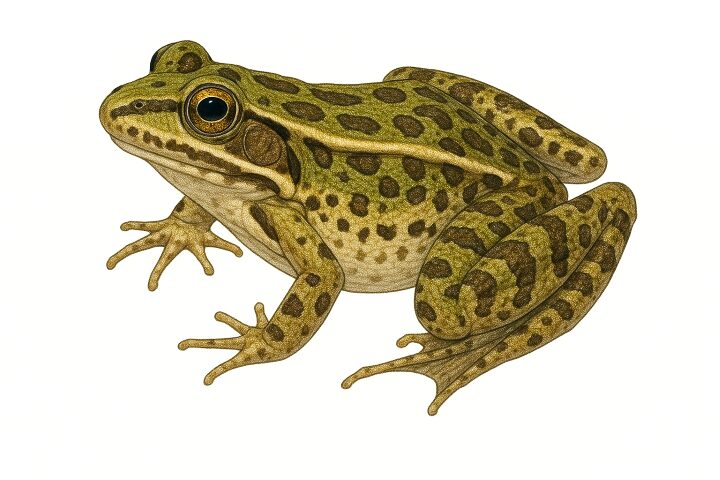
The Vegas Valley Leopard Frog is a fascinating amphibian with a bit of mystery behind it. Believed to be extinct for decades, this frog was once native to a small corner of southern Nevada. Its story captured the attention of scientists and conservationists alike, and it’s become something of a symbol for amphibian conservation efforts in arid regions.
Size & Physical Appearance
Vegas Valley Leopard Frogs were medium-sized for a leopard frog species. Adults ranged from about 2 to 3.5 inches long (5 to 9 cm). Like other leopard frogs, they had a slim, athletic build with powerful hind legs for hopping and swimming.
Their skin was typically olive green to light brown, covered in distinctive dark spots — a hallmark of leopard frogs. A pale or cream-colored stripe ran along each side of their back, and they had a white underside. Males were usually smaller than females and had larger thumbs and vocal sacs for calling during the breeding season.
Habitat and Range
This species had one of the most limited natural ranges of any North American frog. It was only known to live in the Las Vegas Valley of southern Nevada, mostly at springs, streams, and marshy wetlands in the Mojave Desert.
These wetlands were rare and isolated by desert, which made the frogs especially vulnerable when their habitats started disappearing. Most of their known habitat was located below 3,000 feet elevation.
Diet
Vegas Valley Leopard Frogs were generalist carnivores, like most frogs. Their diet included a variety of insects and small invertebrates — beetles, ants, flies, spiders, moths, and occasionally even smaller frogs if they could manage it. Froglets (young frogs) ate smaller prey like tiny insects and aquatic larvae.
They were ambush predators, sitting still and striking when an insect wandered too close.
Lifespan
The exact lifespan of the Vegas Valley Leopard Frog isn’t well-documented, but related leopard frog species live about 3 to 6 years in the wild. In captivity, they can sometimes live longer with consistent care.
Identification Tips
The Vegas Valley Leopard Frog looked very similar to other leopard frogs, especially the Rio Grande Leopard Frog and Lowland Leopard Frog. But there were a few differences:
- Their spots were usually smaller, more widely spaced, and more irregular in shape.
- They lacked the dark bars on the legs that show up on most other leopard frogs.
- The dorsal ridge (the fold running down their sides) was slightly more distinct and straighter.
Today, most identification is done through museum specimens and DNA analysis, since the species is believed to be extinct in the wild.
Fun Fact
This frog was thought to be extinct by the early 1950s — but in 2011, scientists realized that what was once thought to be a different species in Arizona was actually a genetic match to the original Vegas Valley Leopard Frog! That discovery opened up possibilities for reintroduction or conservation breeding, showing just how surprising the world of amphibians can be.
Final Thoughts
The story of the Vegas Valley Leopard Frog is both a cautionary tale and a hopeful one. It’s a reminder of how fragile isolated species can be — and how important it is to protect unique habitats before it’s too late. Whether you’re a student, a nature lover, or just curious about frogs, this is a species worth remembering.