
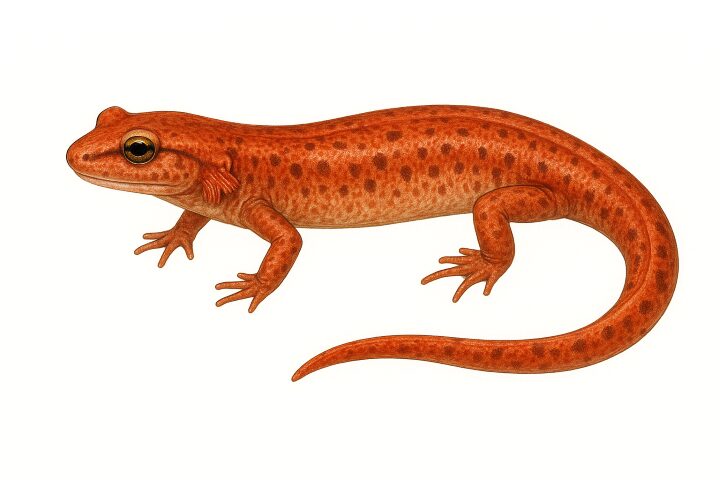
The West Virginia Spring Salamander is one of the rarest amphibians in the United States — and possibly the most elusive. Found only in a single cave system in Greenbrier County, West Virginia, this species is truly a hidden gem. Its unique cave-dwelling lifestyle and extreme rarity make it an exciting species for biologists and salamander enthusiasts alike.
Size & Physical Appearance
This medium-sized salamander typically measures between 4 to 5.5 inches long from snout to tail. It has a slender body with a broad, flat head and a blunt snout, which is characteristic of species adapted to life in caves.
Its skin is usually a pale pinkish or salmon color, and sometimes appears almost translucent. That light coloration is no accident — this salamander has evolved in dark environments where camouflage is less important. Some individuals have faint spotting, and you might notice reduced pigmentation in the eyes too, which is another common adaptation for cave life.
There’s little known difference between males and females in appearance, and juveniles tend to look like smaller versions of the adults.
Habitat and Range
You won’t be spotting this salamander on a casual walk through the woods. The West Virginia Spring Salamander is known to exist only in a specific cave system: General Davis Cave in Greenbrier County, West Virginia. That makes it endemic to just one spot on the planet — about as local as you can get.
They live in cool, subterranean freshwater habitats, including underground streams and spring-fed pools. These caves maintain a relatively stable temperature, which is ideal for a salamander that doesn’t migrate far and depends on a very specific set of conditions to survive.
Because of its extremely limited range and specialized habitat, this salamander is considered endangered and is protected under conservation efforts.
Diet
In the wild, this species likely feeds on small cave-dwelling invertebrates such as:
- Insects
- Spider-like creatures
- Microscopic aquatic organisms
Not much is directly observed due to how tough it is to study them in the wild, but they are thought to ambush prey using quick strikes, much like closely related species. Being a top predator in their small ecosystem, they’re a vital part of the cave food web.
Lifespan
The lifespan of the West Virginia Spring Salamander is still being studied, but similar species in the genus Gyrinophilus can live 10 to 15 years in the wild. Since this salamander lives in a stable cave environment with fewer predators and fewer environmental fluctuations, it may live even longer. In captivity, there’s very limited data, mainly due to the species’ protected status and the difficulty of replicating its habitat.
Identification Tips
The West Virginia Spring Salamander is easy to confuse with the more common Spring Salamander (Gyrinophilus porphyriticus), especially since that species also occurs in West Virginia.
Here are a few things to look out for:
- Coloration: The West Virginia Spring Salamander is much paler, often pinkish or light salmon, whereas the Spring Salamander tends to be a more vibrant salmon, orange, or even reddish color.
- Habitat: If you’re not deep inside a protected cave in Greenbrier County, you’re probably not looking at a West Virginia Spring Salamander. The regular Spring Salamander is found widely in forested streams and springs.
- Other features: The cave-dwelling salamander may show signs of reduced eyesight and lighter pigmentation overall, typical of species adapted to long-term subterranean life.
Fun Fact
This salamander is so rare, biologists have only confirmed its presence in one cave system since its discovery in 1951. Trying to find one is like searching for a needle in a haystack — in the dark, underwater, and underground.
In Summary
The West Virginia Spring Salamander is a fascinating example of how life adapts to extreme environments. Found nowhere else in the world, this cave-dwelling species is both a biological curiosity and a conservation priority. If you’re a fan of hidden biodiversity and secretive creatures, this salamander is as mysterious as it gets.
Just remember — it’s not something you’re likely to stumble upon, and because of its extreme rarity and protected habitat, the best way to appreciate this species is by learning about it, not going looking.
Explore More
Curious about other cave-loving amphibians? Or wondering how the Spring Salamander compares? Check out our profiles on:
Want to help amphibians? Supporting local conservation efforts and clean water initiatives goes a long way, especially for species like this, whose entire future depends on a single, vulnerable ecosystem.