
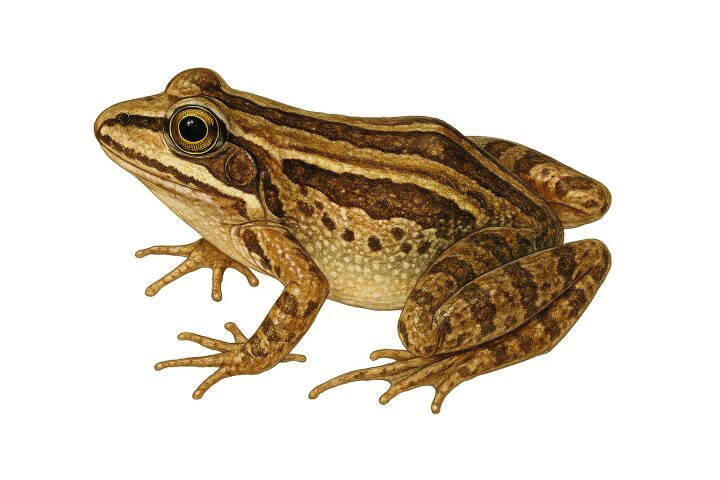
The Western Chorus Frog might be small, but it packs a serious punch when it comes to personality and volume. Despite being only about the length of a paperclip, this little frog is famous for its loud, buzzy call that signals the start of spring in many parts of the central and eastern U.S. If you’ve ever walked near a marsh or wet field after a rainy day and heard what sounds like someone running a finger down a comb, you’ve probably heard the Western Chorus Frog in action.
Size & Physical Appearance
Adult Western Chorus Frogs usually measure between 0.75 to 1.5 inches long. They’re small, slender frogs with smooth skin and a rounded snout.
Color varies quite a bit, but they’re typically a light brown or greenish-tan with three dark stripes down the back. (Those stripes are actually what the species name triseriata refers to.) Some frogs also have spots or slightly broken lines instead.
There’s a dark stripe running from the nose, through the eye, and along the side of the body, which is a helpful identification clue. The belly is usually pale and unmarked. Males tend to be slightly smaller than females and have a darker throat, especially during breeding season when they’re calling.
Habitat and Range
Western Chorus Frogs live in a wide variety of habitats, as long as there’s some type of water during the breeding season. You’ll find them in marshes, meadows, roadside ditches, grassy fields, open woods, and even suburban backyards.
Their range covers parts of the Midwest, Great Plains, and southeastern Canada, including states like Illinois, Iowa, Kansas, Missouri, Nebraska, Minnesota, Wisconsin, Indiana, and Ohio. They’re adaptable and can live from near sea level up to moderate elevations.
Diet
Like many small frogs, the Western Chorus Frog feeds mainly on tiny insects and other invertebrates. This includes ants, flies, beetles, spiders, and small caterpillars. Tadpoles primarily graze on algae and decaying plant matter in the water.
What’s cool about their diet is that it makes them mini pest control agents for their ecosystem. Even though they’re small, they eat a surprising number of bugs.
Lifespan
In the wild, Western Chorus Frogs usually live about 2 to 3 years. In captivity, with the right care, they may live longer — but precise data is limited since they’re not commonly kept as pets.
Identification Tips
This species can be tricky to identify because it looks a lot like the Spring Peeper and other chorus frogs.
Here are some good tips for telling it apart:
- Look for the three dark stripes running down the back — though keep in mind they can be broken or faint in some frogs.
- Listen to the call — it sounds like someone running their finger down a plastic comb. This is one of the clearest ways to distinguish them during breeding season.
- Compared to the Spring Peeper, which has an X-shaped mark on its back, the Western Chorus Frog has more linear stripes.
- Unlike the Gray Treefrog, which has warty skin and toe pads for climbing trees, the Western Chorus Frog is smoother and usually sticks closer to the ground.
Fun Fact
Western Chorus Frogs can freeze solid in the winter and survive. They produce natural antifreeze proteins in their bodies that protect vital organs while the rest of their body literally freezes. When spring comes and temperatures rise, they thaw out and hop right back to life — a pretty amazing survival trick for such a tiny creature.
If you’re out in early spring and hear that characteristic comb-like trill near a wetland, slow down and listen. There’s a good chance you’re in the company of the Western Chorus Frog — loud, lively, and a sure sign that warmer days are on their way.