
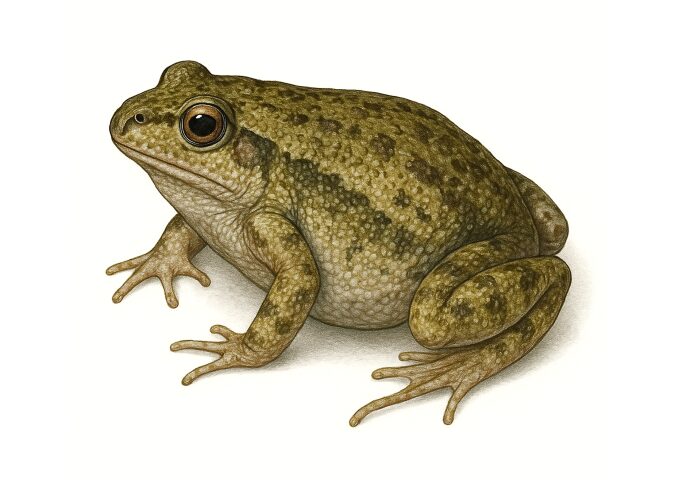
The Western Narrow-mouthed Toad (Gastrophryne olivacea) might not win any beauty contests, but it’s a fascinating little amphibian with some impressive quirks. Despite its name, it isn’t a true toad—and it doesn’t spend much time in water either. These small, secretive creatures are experts at hiding, emerging mostly after rains to feed and breed. They’re more often heard than seen, with males making their high-pitched, buzzy calls from under leaf litter or inside cracks in the ground.
Size & Physical Appearance
These toads are tiny. Adults usually measure between 1 to 1.5 inches long, and their bodies are shaped like teardrops—broad at the back and narrowing toward the head. They have a smooth, almost rubbery-looking skin (unlike the warty skin of “true” toads), and their coloration tends to be gray, olive-brown, or dark brown, sometimes with darker mottling or lighter stripes down the back.
Their most distinctive feature is the small, pointed snout and extremely narrow mouth—hence the name. Males and females look quite similar, though during the breeding season, males develop a dark throat patch.
Juveniles are simply smaller versions of adults, though they may appear slightly lighter in color at first.
Habitat and Range
Western Narrow-mouthed Toads thrive in warm, dry, and often rocky areas. You’ll find them in grasslands, open woodlands, desert edges, and even urban fringes where there’s enough cover like loose soil, rocks, leaf litter, or debris piles.
They’re mostly found across the central and southwestern United States, including:
- Texas (common across much of the state)
- Oklahoma
- Kansas
- New Mexico
- Colorado (southeastern part)
- Eastern Arizona
- Northern Mexico
They typically live at lower elevations but can be found in higher areas if conditions are right. Because they’re sensitive to cold, they’re more active in warmer months and will retreat underground when it gets too chilly.
Diet
These little amphibians have a very specific appetite—they love ants. In fact, ants make up the majority of their diet. Their narrow mouths are especially good at slurping up the tiny insects. They’ll also eat termites, small beetles, and other tiny arthropods when available. Their sticky tongue is quick and efficient, and they’re surprisingly active hunters during warm, humid nights.
Lifespan
In the wild, Western Narrow-mouthed Toads are thought to live around 4 to 6 years, though it could be longer depending on environmental conditions. In captivity, they may live a bit longer, but they’re not common pets and don’t adapt especially well outside their natural setting.
Identification Tips
Because of their small size and secretive nature, these toads are often mistaken for other small amphibians—especially young toads or chorus frogs. Here’s how to tell them apart:
- Snout shape: Their head is sharply pointed with a very narrow mouth. Most other frogs and toads have broader heads.
- Skin texture: Smooth and rubbery, not bumpy or warty like true toads.
- No visible eardrum (tympanum): Unlike many frogs and toads, the tympanum is either absent or very hard to see.
- Legs: Short and stubby. Not built for long-distance jumps. They tend to crawl more than hop.
If you hear a loud, insect-like buzz coming from leaf piles or underneath rocks after a rain in summer, it might be a male calling for a mate.
Fun Fact
These toads have a special defense against eating their favorite food—ants. Ants can be aggressive and might release formic acid as a defense, but Western Narrow-mouthed Toads have thick skin and special mucus around their mouths that helps them avoid being stung or harmed while feeding. It’s a great example of evolution fine-tuning an amphibian’s defenses to match its diet!
Whether you’re flipping logs in Texas or listening for strange buzzes on a warm summer night, keep an eye (and ear) out for this little toad. It’s a master of staying hidden—but once you know what to listen and look for, you’ll be in on one of nature’s best-kept secrets.