
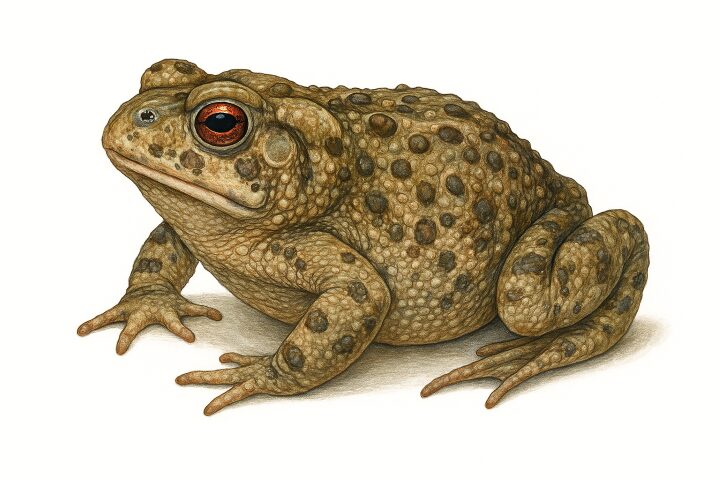
The Wyoming Toad is one of the rarest amphibians in North America — and possibly the entire world. Once common around the Laramie Basin in Wyoming, this little toad nearly vanished in the 1970s. Today, it’s a symbol of conservation and recovery, with captive breeding programs working to keep it from going extinct. If you ever get the chance to see a Wyoming Toad, consider yourself lucky — they’re usually off-limits to the public and only found in protected habitats.
Size & Physical Appearance
Wyoming Toads are pretty small as far as toads go. Adults are usually between 2 to 2.5 inches long (that’s about 5 to 6.5 cm). Their skin is typically dark brown or grayish, often covered with small warts. They’ve also got darker blotches on their backs and sometimes a light stripe down the middle.
Juveniles tend to have brighter and more contrasting markings, but colors can vary quite a bit from toad to toad. Males are usually smaller than females and might have darker throats, especially during the breeding season when they’re calling.
Habitat and Range
Historically, Wyoming Toads lived in the Laramie River Basin in southeastern Wyoming. Today, that’s still the only place they’re found — and only in a few secluded spots. They prefer shortgrass prairie areas with lots of wetland features like ponds, lakeshores, and seepage zones.
These toads like low-elevation wetlands and rely heavily on water during the breeding season. Drought, habitat loss, and pollution have made their already small range even smaller, so conservationists have reintroduced captive-bred toads into protected areas.
Diet
Like most toads, the Wyoming Toad is an insectivore. It primarily eats small invertebrates like ants, beetles, flies, spiders, and caterpillars. Tadpoles are grazers and feed on algae or decaying organic matter in the water.
What’s especially cool is that they help control insect populations naturally, making them valuable players in their ecosystem — even if their presence is modest due to their rarity.
Lifespan
In the wild, data is limited since these toads are so rare, but their lifespan is estimated at around 3 to 6 years. In captivity, where conditions are controlled and predation isn’t an issue, some toads have lived up to 10 years.
Identification Tips
Because they’re so rare and live such secluded lives, you’re unlikely to come across a Wyoming Toad in the wild. But if you happen to be working with biologists or visiting a conservation site, here’s what to look for:
- Size: On the smaller side for a toad, about 2–2.5 inches.
- Color: Usually dark brown or gray with darker blotches and warty skin.
- Skin Texture: Dry and bumpy with short, stubby limbs.
- No prominent cranial crests: Unlike some other toads like the American Toad, the Wyoming Toad has very reduced or absent cranial ridges on its head.
If you’re comparing it to the more common Western Toad or American Toad, the Wyoming Toad is typically smaller and has more muted coloring. Also worth noting: the Wyoming Toad is fully protected, so all monitoring and interaction are handled by trained professionals.
Fun Fact
The Wyoming Toad was once thought to be extinct — in fact, it completely disappeared from the wild by the mid-1990s. But a tiny group of individuals found in 1987 kickstarted an emergency captive breeding effort. Thanks to the dedication of conservation teams, hundreds of toads have since been raised and released into protected habitats. It’s one of the few amphibian species with an ongoing legal recovery program in the United States.
In a Nutshell
- Scientific name: Anaxyrus baxteri
- Status: Critically Endangered (federally listed)
- Range: Laramie River Basin, Wyoming
- Habitat: Wetland edges in shortgrass prairie
- Key features: Small size, warty brownish-gray skin, and absence of cranial crests
Even though you’re unlikely to spot one outside of a conservation setting, the Wyoming Toad is a great example of how even the smallest creatures can make a big impact. Its story helps remind us how fragile amphibian populations can be — and why species recovery efforts matter.