
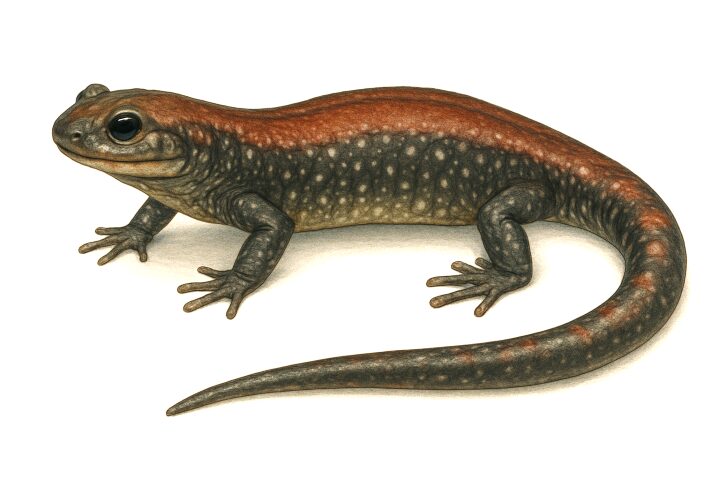
The Yonahlossee Salamander is a striking amphibian found in the cool Appalachian Mountains. With its dark body and bold reddish back patch, it’s one of those salamanders you don’t easily forget once you’ve seen it. This secretive, woodland-dwelling species spends much of its life hidden under leaf litter or rock outcroppings and only becomes active during cool, damp weather. For amphibian fans and hikers in the Southeast, spotting one feels like a real nature treasure.
Size & Physical Appearance
Adult Yonahlossee Salamanders typically measure between 4 to 6.5 inches in total length. Their appearance is fairly dramatic — a deep black or dark brown body sets off a broad, rusty-red to orange-brown stripe running along their back and upper tail. Their sides are patterned with white or bluish spots, and their undersides are usually gray.
There aren’t any glaring differences between males and females in the field, but during the breeding season, males can develop slightly swollen jaw muscles. Juveniles, meanwhile, may have paler coloration and less defined dorsal stripes, but they still show that patterned look.
Habitat and Range
The Yonahlossee Salamander is a true specialist. It’s found mainly in the southern Appalachian Mountains, especially in high-elevation forests of western North Carolina, eastern Tennessee, and southwestern Virginia. They tend to live in areas of moist, shaded deciduous or mixed forests with plenty of moss, leaf litter, and rock cover.
Most populations are clustered at elevations of about 2,500 to 5,000 feet, and they prefer forested slopes, often near streams or seeps — though they’re not considered aquatic.
Diet
Despite their dramatic appearance, Yonahlossee Salamanders are humble hunters. Like most plethodontid (lungless) salamanders, they feed mostly at night on small invertebrates. That includes insects, spiders, worms, and small snails. They rely heavily on their strong sense of smell and quick, sticky tongues to catch prey — it’s almost like the way a frog catches insects.
They don’t hunt big, flashy game, but they help keep the forest floor clean and balanced by being insect predators.
Lifespan
In the wild, Yonahlossee Salamanders likely live about 7 to 10 years, though precise data is limited (they’re tough to study in the wild due to their secretive nature). In captivity, similar salamander species have lived even longer, but this species is rarely kept in captivity due to its habitat needs and protected status.
Identification Tips
The Yonahlossee Salamander can be confused with other large Plethodon salamanders, like the Northern Slimy Salamander (Plethodon glutinosus). Here’s how to tell them apart:
- Look for the red stripe: The Yonahlossee is one of the few eastern salamanders with a broad reddish-brown dorsal patch. Slimy Salamanders, by contrast, are dark with scattered white or silver spots, but no stripe.
- Check the habitat: Yonahlossees are found at higher elevations and prefer moist, sloped forest floors with lots of rocks. If you’re lower down or in a flatter area, you might be looking at a different species.
- Size and build: Yonahlossee Salamanders have relatively long bodies and tails with a more striking contrast between their red back and darker body.
Always take a photo (without touching the salamander) if you’re not sure — it helps with ID later without disturbing the animal.
Fun Fact
Unlike many amphibians, Yonahlossee Salamanders don’t go through a tadpole stage. They hatch from eggs directly into tiny, fully-formed salamanders. That’s because they are part of the lungless salamander family (Plethodontidae), and fully terrestrial from day one. They even breathe through their skin and the lining of their mouths — no lungs required!
In Closing
The Yonahlossee Salamander is a beautiful and specialized creature, perfectly adapted to the cool, damp forests of the southern Appalachians. For anyone who loves hiking in those mountains, it’s a symbol of the region’s rich biodiversity and the kind of hidden gem you might find if you’re quietly exploring in the woods after a rain. Just remember — admire with your eyes, not your hands. They’re sensitive animals and do best when left undisturbed.
Keep your eyes peeled, tread carefully, and you just might spot one of these mountain marvels on your next woodland walk.