
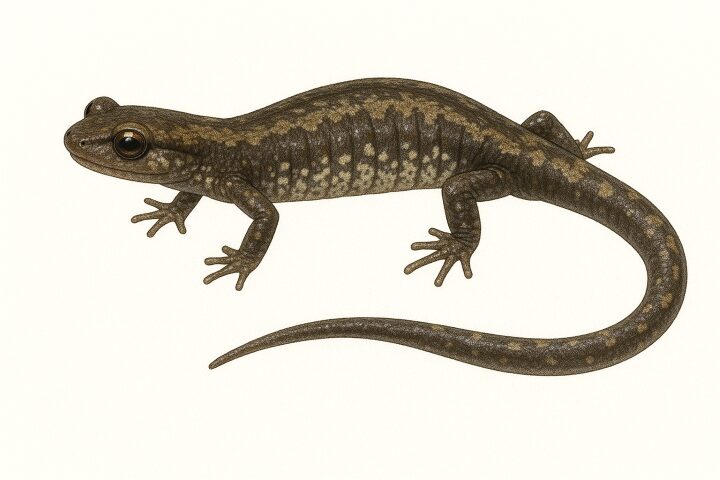
The Wandering Salamander is a small, secretive amphibian with a big personality for its size. What really makes this species stand out? It can actually “parachute” through the air. Yes, really — this little climber can glide from tree to tree in the California redwoods, making it one of the coolest arboreal salamanders out there. It’s known for living high up in the forest canopy, a trait that’s rare among salamanders. Despite its name, it’s not exactly a globe-trotter, but it does have a fascinating (and slightly mysterious) distribution.
Size & Physical Appearance
Adult Wandering Salamanders typically measure between 2.5 to 4 inches in total length, including their tail. They’re slim-bodied with relatively long legs and toes, which helps them grip bark and climb.
Their coloration ranges from dark gray to brown or bronze, often speckled with fine silvery or greenish flecks — almost like someone dusted them with glitter. Their bellies are usually a lighter gray. Juveniles look similar but tend to be smaller and may have a slightly more vibrant or contrasting pattern.
There aren’t obvious differences between males and females in the wild, but males may sometimes have slightly broader heads during breeding season.
Habitat and Range
This salamander prefers moist, forested environments, especially in coastal areas. It’s most famously found in the redwood forests along the northern California coast. There are also populations on Vancouver Island in British Columbia, which is unusual and still a bit of a puzzle for biologists — how did they get there?
They’re usually found in dead logs, under bark, or inside mossy tree cavities. But what sets them apart is their use of the canopy. These salamanders don’t just hang out on the forest floor — they spend much of their time way up in the trees, particularly in the cool, damp upper reaches of old-growth forests.
Diet
Wandering Salamanders are insectivores and feed mostly at night. Their diet includes:
- Tiny insects
- Spiders
- Springtails
- Other small invertebrates they find among mosses and tree bark
They use their sticky tongues to snatch prey in tight spaces, whether on the ground or up in the trees.
Lifespan
In the wild, Wandering Salamanders can live at least 5 to 8 years, although information is a bit limited due to how secretive they are. In captivity (which is rare and usually limited to research), they may live longer with ideal care, but we don’t have a ton of data.
Identification Tips
Wandering Salamanders can be tricky to ID because they resemble other woodland salamanders, especially the Arboreal Salamander (Aneides lugubris). Here’s how to tell them apart:
- Wandering Salamanders are usually smaller, slimmer, and have slightly shorter, more delicate heads compared to Arboreal Salamanders.
- They also lack the distinct yellow or gold spots that some Arboreal Salamanders have.
- The Wandering Salamander’s coloration is more silvery or gray-brown instead of the deeper brown typical of Arboreal Salamanders.
- If you’re in a redwood forest or on Vancouver Island and you spot a slim salamander high in the trees, odds are you’re looking at a Wandering Salamander.
Don’t confuse them with Ensatina species either — Ensatinas have a constriction at the base of their tails, which is absent in Wandering Salamanders.
Fun Fact
These salamanders can actually glide through the air! When they fall from high tree branches (which happens more often than you’d think), they splay out their limbs and tails to control their descent, kind of like a flying squirrel. Researchers discovered this behavior while studying populations in redwood trees. It’s one of the few documented cases of aerial gliding in amphibians!
In Summary
The Wandering Salamander is a quiet but impressive resident of the Pacific Northwest’s towering coastal forests. With its climbing skills, night-time hunting habits, and tree-top gliding antics, it’s a reminder of just how diverse and surprising amphibians can be.
If you’re ever hiking through a redwood forest and spot tiny eyes peeking out from under bark or moss — take a moment. You might be looking at one of nature’s smallest aerial acrobats.