
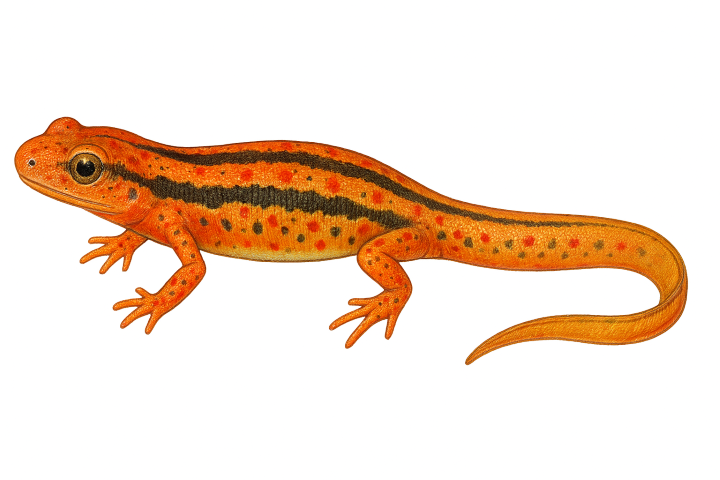
The Striped Newt (Notophthalmus perstriatus) is one of the Southeast’s most eye-catching amphibians. Easily recognized by its bold racing stripes and unique life cycle, this little newt is both charming and rare. It’s found in a very limited range in the U.S., and if you’re lucky enough to spot one, you’re looking at a creature that’s as impressive as it is elusive.
Striped Newts are known for their striking coloration, quirky “teenage” stage known as the eft phase, and dramatic migrations that take them to temporary ponds each spring. Unlike many amphibians, they spend part of their life both on land and in water — and they look completely different in each stage.
Size & Physical Appearance
These newts are on the small side:
- Length: 2.5 to 4 inches as adults (including tail)
In terms of looks, there’s no mistaking them:
- Adults have a yellow-green to olive body with two orange or reddish stripes running down their back — and a dotted belly
- Juveniles, called efts, are bright orange-red with faint dark spots and rougher skin
Males and females look pretty similar, although mature males in breeding condition may develop extra tail fins and slightly swollen vents.
Habitat and Range
Striped Newts are found only in parts of Florida and southern Georgia, and even within that range, their populations are patchy and declining.
They like habitats with:
- Longleaf pine sandhills and scrubby flatwoods
- Temporary ponds and shallow wetlands for breeding
They’re able to live both in water and on land. Once breeding season is over, many move into the surrounding uplands, sometimes hiding underground for long periods. They’re rarely seen outside of breeding season, which makes them feel kind of like amphibian ghosts — here one minute, gone the next.
Diet
Striped Newts are carnivores and not picky eaters — though they’re pretty small, so their menu matches.
They eat:
- Insects
- Small crustaceans
- Worms
- Other tiny invertebrates
Larval and aquatic adults will also eat small aquatic prey like mosquito larvae and planktonic critters. Efts (the land-based juveniles) hunt on the forest floor.
Lifespan
In the wild, Striped Newts can live around 4 to 6 years. In captivity (like in conservation programs), they’ve been known to live a little longer under ideal conditions.
Identification Tips
There are several newts in the Southeast, but here’s how to tell the Striped Newt apart:
- Eastern Newt: A close cousin. Eastern Newts lack the distinctive stripes and tend to be more greenish-brown overall. Their efts are redder and more spotted.
- Tiger Salamander: Much larger and chunkier, with bold spots or blotches, no stripes.
If you see a small, slender newt with orange-red stripes in sandy uplands or near a shallow pond in the Florida-Georgia line, chances are you’ve found yourself a Striped Newt.
Fun Fact
Striped Newts can pause their development — in some places, they skip the adult land stage entirely and stay aquatic for life. This condition, called paedomorphosis, lets them stay in the water where conditions are stable. It’s one of nature’s cool backup plans!
Conservation Note
Sadly, the Striped Newt is in serious trouble. Habitat loss, fire suppression, and pond draining have caused their numbers to plummet. They’re under review for federal protection, and biologists are working hard to reintroduce them to some areas.
If you live in their range and want to help, you can support prescribed fire programs and protect wetland habitats — and always avoid releasing anything into ponds where native amphibians live.
In Summary
The Striped Newt is one of the Southeast’s most unique amphibians — colorful, secretive, and full of surprises. From its bold stripes to its disappearing act in upland forests, this little newt is a fascinating part of the natural world worth protecting.
If you ever spot one, snap a photo (from a distance) and enjoy the moment — it’s a rare treat!