
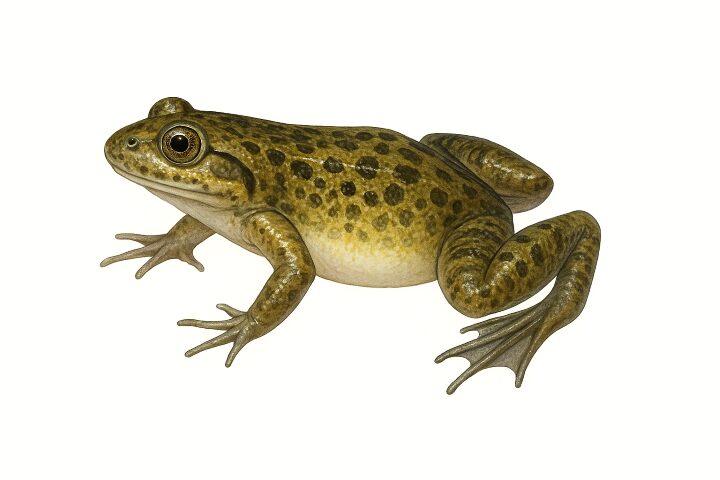
Meet the Tropical Clawed Frog — a fully aquatic, smooth-skinned amphibian that’s a bit of a science star. This small frog is native to parts of Africa, but it’s been introduced to the U.S. in labs and, in some cases, outdoor ecosystems. What makes it stand out? Besides having claws on its feet, it’s also one of the only frogs with a completely sequenced genome, making it a favorite in scientific research. But even outside the lab, it’s an interesting little frog with a lifestyle all its own.
Size & Physical Appearance
Tropical Clawed Frogs are on the smaller side compared to other clawed frogs. They typically grow to about 1 to 2 inches long (about 3 to 5 cm).
Their bodies are flattened and smooth, and they don’t have external ears or tongues like most frogs. Their skin is usually a pale to medium brown with mottled gray or olive-green spots. You’ll also notice their unusually long back toes, which are fully webbed and tipped with tiny black claws — hence the name. Unlike other frogs, their front feet aren’t webbed.
Males are usually slightly smaller and thinner than females, and females tend to have a rounder, heavier body, especially when carrying eggs.
Habitat and Range
Even though they’re native to western and central Africa, Tropical Clawed Frogs have occasionally been found in the wild in the United States, especially in warm, freshwater environments. They’re not widely established in the U.S. like their cousin, the African Clawed Frog (Xenopus laevis), but they may turn up as abandoned pets or lab animals.
They’re fully aquatic, so they stick to still or slow-moving freshwater environments like temporary ponds, marshes, and quiet sections of streams. They don’t need lush surroundings — just warm, oxygenated water and a soft substrate. They’re generally not found at high elevations.
Diet
These frogs aren’t picky eaters. In the wild, they’re opportunistic predators that snap up just about anything small enough to fit in their mouth. That includes tiny fish, insects and insect larvae, worms, crustaceans, and just about any protein source they can catch.
Tropical Clawed Frogs don’t have tongues, so they use their front limbs to stuff food into their mouths, kind of like little paddles. In captivity, they’ll readily eat pellets, brine shrimp, or bloodworms.
Lifespan
In the wild, their lifespan is likely 5 to 8 years, though that can vary depending on predators and environmental conditions. In captivity, they can live even longer — often over 10 years with proper care.
Identification Tips
Tropical Clawed Frogs are often confused with African Clawed Frogs (Xenopus laevis), but here’s how to tell them apart:
- Size: Tropical Clawed Frogs are smaller — usually less than 2 inches long. African Clawed Frogs can reach over 4 inches.
- Eyes: Their eyes sit more on top of their heads, giving them a peeking-above-the-water look.
- Body Shape: They’re more compact and shorter-bodied, with smoother skin and less prominent webbing between front toes.
- Color: Tropical Clawed Frogs tend to be more speckled and mottled, with a mix of light brown and gray-green shades, while their African cousins are often a solid, uniform color.
If you see a small, fully aquatic frog in a warm pond with tiny claws on its back feet and no eyelids or tongue — you’re probably looking at one.
Fun Fact
This little frog has the honor of being the first amphibian to have its entire genome sequenced. That made it a big deal in genetic research, especially in studies looking at development and disease. Scientists love them, and thanks to that, we now know a lot more about how vertebrates grow and function.
So while you might not run into this species on a weekend hike, it’s still a fascinating part of the amphibian world — both in and outside the lab.