
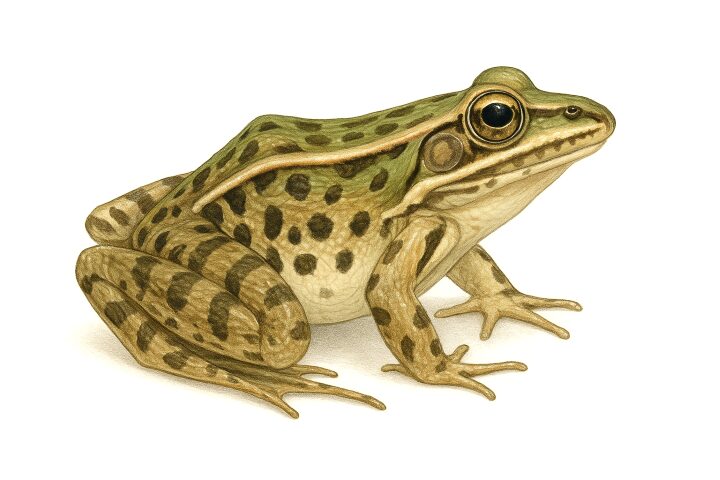
If you’ve ever walked near a pond or wetland in the southeastern U.S., chances are you’ve heard the rapid chuckling call of the Southern Leopard Frog. Named for its distinct spots and quick hops, this frog blends in well with its surroundings but is anything but boring. It’s common, adaptable, and one of the easiest frogs to spot—if you know what to look (and listen) for.
Size & Physical Appearance
Southern Leopard Frogs are medium-sized amphibians, usually ranging from 2 to 4 inches in length. They get their name from the dark, irregular spots that dot their back and legs, kind of like a leopard’s. These spots are one of their easiest features to recognize.
Their base color varies from bright green to brown, sometimes with a slight yellowish tint. They have two distinct light folds (dorsolateral ridges) that run from behind the eyes down the back, typically lighter than the rest of the body. Their underbellies are usually pale or white.
One detail to watch for: males tend to be slightly smaller and may have darkened or swollen thumbs during breeding season. Juveniles look like smaller versions of adults but with less defined markings.
Habitat and Range
You can find Southern Leopard Frogs in a wide variety of habitats—they’re surprisingly flexible. They do best around freshwater environments like ponds, lakes, marshes, slow-moving streams, and wet meadows. They’re even comfortable in roadside ditches if the water sticks around long enough.
This species is found throughout the southeastern and south-central United States. Their range stretches from Texas to Florida and up the East Coast to about New Jersey, and west into parts of Oklahoma and Kansas. They tend to stay at lower elevations but can also be seen in foothills.
Diet
Southern Leopard Frogs are classic carnivorous amphibians. Their diet includes pretty much anything they can catch and fit in their mouth. That means:
- Insects like beetles, flies, and grasshoppers
- Spiders
- Worms
- Small crustaceans
- Even the occasional small frog or tadpole (including their own species!)
They hunt mostly at night by waiting motionless until prey wanders close, then striking quickly with a sticky tongue. They’re surprisingly good at snagging fast-moving insects.
Lifespan
In the wild, Southern Leopard Frogs typically live 2 to 4 years, though some may make it to around 5 years if conditions are good and predators stay away. In captivity, with proper care, they might live a bit longer, up to 6 years, but they’re not commonly kept as pets.
Identification Tips
Southern Leopard Frogs are often confused with Pickerel Frogs. Here’s how you can tell them apart:
- Spot shape: Leopard frogs have random, round dark spots on their back, while Pickerel Frogs have more rectangular spots arranged in neat rows.
- Inner thigh color: Southern Leopard Frogs usually have pale or yellowish inner thighs, while Pickerel Frogs display bright orange or yellow on their inner thighs.
- Call: The Southern Leopard Frog’s call sounds like a rapid chuckle or squeaky laugh. It’s quite different from the low snore-like call of Pickerel Frogs.
Fun Fact
The Southern Leopard Frog is one of the first frogs to begin calling in the spring, sometimes even when temperatures are just above freezing. On mild winter nights in the South, you might hear them calling and see them hopping around long before other frogs have even emerged from hibernation.
They’re also known to leap over 3 feet in a single jump when startled—a pretty impressive distance for a four-inch frog!
Wrapping Up
The Southern Leopard Frog is a great ambassador for amphibians: adaptable, widespread, and easy to spot (or hear) if you know where to look. Whether you’re a teacher leading a frog walk, a family visiting a local pond, or a budding herper building your life list, this charismatic frog is a fun and familiar presence in much of the U.S.
Watch near the water’s edge just after sunset—and listen for that signature chuckle. You might not see them right away, but if you stay still and patient, a leopard frog might just hop into view.