
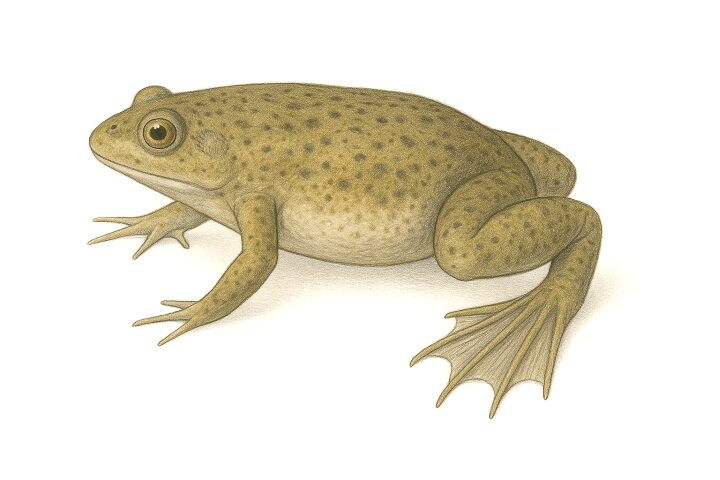
The African Clawed Frog is one of those species that seems straight out of a sci-fi movie. Native to sub-Saharan Africa but now found in parts of the United States due to introductions, this fully aquatic frog is known for its wild feeding behavior, odd clawed toes, and big role in the history of medicine. It’s a survivor, a scavenger, and a surprisingly influential amphibian.
Size & Physical Appearance
African Clawed Frogs are medium-sized compared to other frogs. Most adults grow between 2 to 5 inches long, though females tend to be much larger than males — not an uncommon trait in amphibians.
Their skin is smooth and usually mottled gray, olive, or brown, with pale bellies. They have flattened bodies with strong hind legs and webbed back feet, which they use to swim like little frog torpedoes. What really stands out are the black claws on three toes of each hind foot — and yes, that’s where the name comes from.
Males have black nuptial pads (dark, rough patches) on their forearms during breeding season, which help them grip females during amplexus. Females are bulkier and often visibly swollen with eggs.
Habitat and Range
Originally from southern and eastern Africa, the African Clawed Frog has been introduced to several parts of the United States, mostly due to the pet trade and medical use. Established wild populations exist in southern California, some parts of Arizona, and a few other scattered locations.
These frogs live exclusively in water and prefer still or slow-moving bodies like ponds, canals, and marshes. They’re not picky though — they’re often found in manmade water sources like drainage ditches and reservoirs. They tolerate a wide range of conditions and elevations, making them highly adaptable (and occasionally invasive).
Diet
African Clawed Frogs are opportunistic feeders. They’ll eat just about anything they can catch and swallow:
- Insects
- Small fish
- Worms
- Other amphibians (even smaller frogs)
They use their front limbs to stuff food into their mouths — it’s messy and fascinating to watch. In captivity, they’re often fed bloodworms, brine shrimp, or commercially prepared amphibian diets. In the wild, they scavenge too, sometimes feeding on dead or dying animals.
Lifespan
In the wild, African Clawed Frogs typically live 5 to 8 years. In captivity, though, they can live 15 years or longer with proper care. Their hardiness is one reason they’re such common lab animals and pets.
Identification Tips
There are a few frogs you might confuse with the African Clawed Frog, especially in the regions where they’re not native:
- Western Spadefoot (Spea hammondii): Similar color and size, but spadefoots live on land and only come to water briefly.
- American Bullfrog (Lithobates catesbeianus): Larger and more robust, with eyes above the waterline. Bullfrogs have fully developed tongues and visible eardrums — African Clawed Frogs do not.
If you spot a frog completely underwater with no visible ear drum, clawed hind feet, and no tongue (yes, really — they lack tongues and teeth), it’s probably an African Clawed Frog. They look a little prehistoric.
Fun Fact
Back in the 1930s through the 1950s, African Clawed Frogs were actually used in human pregnancy tests. Doctors would inject a woman’s urine into a female frog, and if the frog laid eggs within 24 hours, it was a positive result. The hormone hCG in the urine triggered egg-laying. It’s a weird but true chapter in medical history.
Final Thoughts
Love them or find them a bit odd, African Clawed Frogs are fascinating animals. While they’re no longer used in medicine, they’ve found a second life in classrooms and aquariums — and unfortunately, sometimes in habitats where they don’t belong. If you see one in the wild in the U.S., it’s worth reporting, because they can be tough on native amphibian populations.
If you’re keeping one as a pet, they’re hardy and entertaining but make sure you never release them into the wild. They’re a great example of how a small frog can have a big impact.