
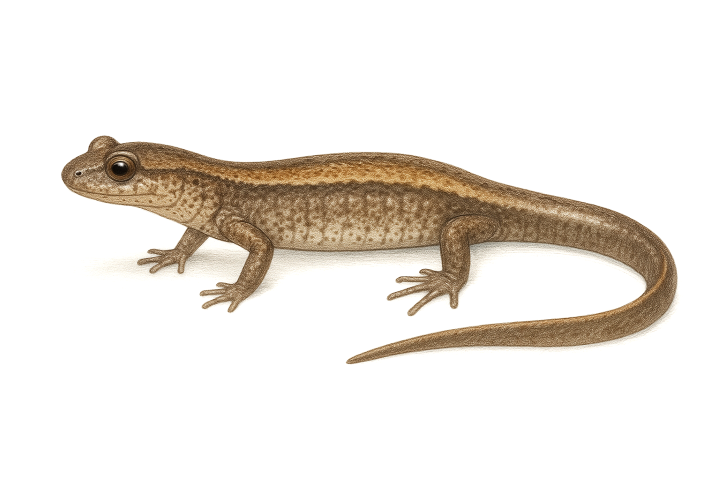
The Allegheny Mountain Dusky Salamander is one of those little forest creatures you might walk right past without even noticing — and that’s part of what makes it so fascinating. Small, secretive, and surprisingly tough, this salamander is a key member of the ecosystems in the Appalachian Mountains. It doesn’t need ponds to breed like many amphibians do, and it’s active even when the weather’s cool and damp. These little guys are also a great indicator of environmental health — if you’ve got dusky salamanders, you’ve probably got clean water and good habitat.
Size & Physical Appearance
Adult Allegheny Mountain Dusky Salamanders usually measure about 2.5 to 5 inches long, including the tail. Their color can vary quite a bit, but they often have a dark brown, gray, or black base with a distinct stripe running down their back. That stripe can be yellow, orange, reddish, or even a kind of light brown. The stripe often has irregular edges or a wavy pattern, which gives them a mottled look.
You’ll also notice they have a rounded tail that becomes laterally compressed toward the tip — a good clue you’re looking at a dusky salamander and not something else. Males and females generally look alike, but males may have slightly widened heads with a broader jawline.
Juveniles often have more pronounced patterns and brighter colors, including rows of tiny white or gold spots along their sides. As they age, those markings tend to fade a bit.
Habitat and Range
Allegheny Mountain Dusky Salamanders love cool, shady, moist environments. You’ll usually find them in forested mountain areas near running water — think small streams, trickles, or seeps. They spend most of their time under logs, rocks, and leaf litter, especially during the day.
This species is native to the Appalachian Mountains and can be found from New York and Pennsylvania down into Georgia and Alabama. They’re especially common in the Allegheny, Blue Ridge, and Cumberland Mountains. Most populations occur at elevations ranging from 1,000 to 4,000 feet, though they can live lower or higher if the moisture is right.
Diet
These salamanders aren’t picky — they eat a variety of small invertebrates. Their diet includes:
- Springtails
- Small insects
- Spiders
- Worms
- Other tiny arthropods
They’re active nighttime hunters, using their sticky tongues to snag prey on the forest floor. When it’s damp and the temperature’s just right, they’ll sometimes even hunt during the day.
Lifespan
In the wild, Allegheny Mountain Dusky Salamanders can live up to 8 or 10 years, although it’s probably closer to 5 to 7 years for most individuals. In captivity, they’ve been known to live a bit longer, sometimes more than 10 years, if conditions are ideal.
Identification Tips
This species can be tricky to ID because its coloring overlaps with other dusky salamanders, which are a group of lookalikes.
Here are some tips:
- Tail shape: The tail starts rounded and becomes flatter toward the tip. Some other dusky species have a tail that’s flattened all the way through.
- Hind legs: The hind legs are noticeably larger than the front legs, which is typical for the genus Desmognathus.
- Dorsal stripe: That wavy or zigzag stripe down the back can help differentiate it from the Northern Dusky Salamander (which usually lacks a clear stripe or has more uniform coloring).
- Habitat: If you’re in higher-elevation forests near a cold stream in the Appalachians, this is likely your species.
If you’re seeing multiple dusky salamanders in the same area, they could be different species living side-by-side — the field of identifying each one can get complicated without a microscope or genetics, but the stripe is your best first clue.
Fun Fact
Allegheny Mountain Dusky Salamanders don’t lay their eggs in water — instead, the female guards the eggs in moist underground nests. She’ll stay with them for weeks, even curling her body around them to protect them from drying out or getting eaten. It’s one of the more nurturing parental behaviors you’ll see in amphibians!
Want to spot one in the wild? Take a careful look under rocks and logs near mountain streams in late spring or early fall. Just be sure to gently replace anything you turn over — salamanders are sensitive creatures, and their homes are easily disrupted.
Let us know if you’ve seen one — or better yet, share your photo!