
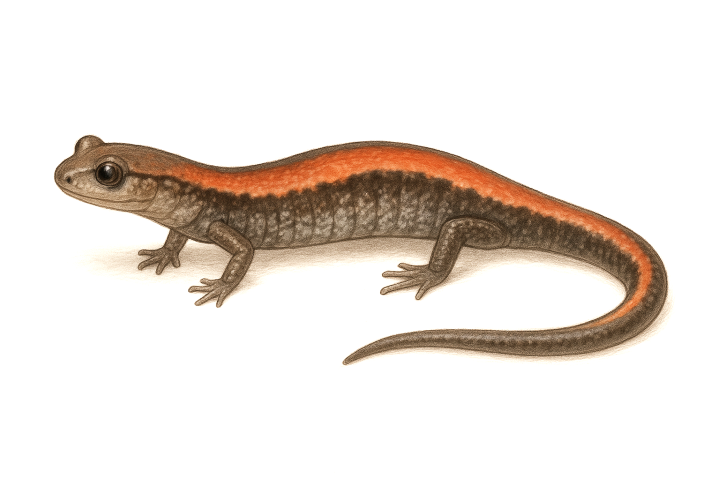
The Eastern Red-backed Salamander is one of those little creatures you might overlook at first — until you flip over a log and find one peeking back at you. This small woodland salamander is especially interesting because it doesn’t have lungs. That’s right — it “breathes” through its skin. Plus, it’s one of the few amphibians that lives completely on land from start to finish. No ponds or puddles needed.
You’ll find Eastern Red-backed Salamanders across the forest floors of the eastern United States, silently doing their part in the ecosystem by munching on insects and aerating the soil. They’re common but fascinating, especially once you know what to look for.
Size & Physical Appearance
These salamanders are small — most adults measure between 2.5 to 4 inches long, including their tail. They have a slender body, smooth skin, and a narrow head compared to some of the chunkier salamanders out there.
There are actually two main color types (called “morphs”) you’ll come across:
- Red-backed morph: A straight, reddish-orange stripe running from the head down the back and tail, with dark gray to black sides.
- Lead-backed morph: No stripe — just a uniform dark gray or black color across the back and sides.
You might also see juveniles with a more coppery or bright stripe and sometimes a bluish tail. The variation can be surprising, so it’s not always about the red stripe!
Habitat and Range
Eastern Red-backed Salamanders love cool, moist forest habitats — especially deciduous or mixed woodlands with lots of leaf litter, rotting logs, and moss. They aren’t fans of heat or dry conditions and are usually found under rocks, logs, and bark during the day.
They’re widely distributed throughout the northeastern and midwestern United States, including states like:
- Maine
- Michigan
- Pennsylvania
- Ohio
- Virginia
Their range even stretches into parts of the southern Appalachians. Most are found at low to mid elevations, but they can be seen in higher elevations where forests remain cool and damp.
Diet
These salamanders are nocturnal hunters. They feed mostly on tiny invertebrates — things like ants, mites, springtails, spiders, beetles, and worms. Basically, if it’s small and squiggly and crawls around the forest floor, it’s probably fair game.
They use their sticky tongues to nab prey, kind of like a miniature frog. In fact, some researchers consider them important in controlling soil insect populations.
Lifespan
In the wild, Eastern Red-backed Salamanders can live up to 10 years — though many don’t make it quite that long due to predators and environmental pressures. In captivity, when cared for properly, they can sometimes live even longer.
That’s a pretty long time for such a small amphibian!
Identification Tips
At first glance, these salamanders can look similar to other small species. Here’s how to tell them apart:
- Versus Northern Two-lined Salamander: Two-lined salamanders are yellowish with two dark lines down their back. Red-backed salamanders are darker and don’t have those paired lines.
- Versus Dusky Salamanders: Dusky salamanders often have stouter bodies and hind legs that are longer than the front legs. Red-backs are slender and have roughly equal-length limbs.
- Check the stripe: While the red-backed morph is easy to ID, the lead-backed one can be trickier. In that case, look at the behavior and habitat. Red-backs stay on land and often don’t enter ponds or streams.
Fun Fact
No lungs — no problem! Eastern Red-backed Salamanders are lungless. They absorb oxygen and release carbon dioxide through their skin and the lining of their mouth. That means their skin has to stay moist, which is one reason they stick to damp environments and aren’t fond of dry weather.
Because they don’t rely on water for breeding, they’re also able to live farther into the forest than many other salamander species.
Final Thoughts
The Eastern Red-backed Salamander may be small and quiet, but it plays a big role in the forest ecosystem. It’s an indicator of environmental health, a predator of soil insects, and kind of a marvel of evolution with that whole no-lungs thing.
Next time you’re out hiking, gently flip a damp log or stone (and be sure to put it back!) — and you just might meet one of these tiny woodland residents.