
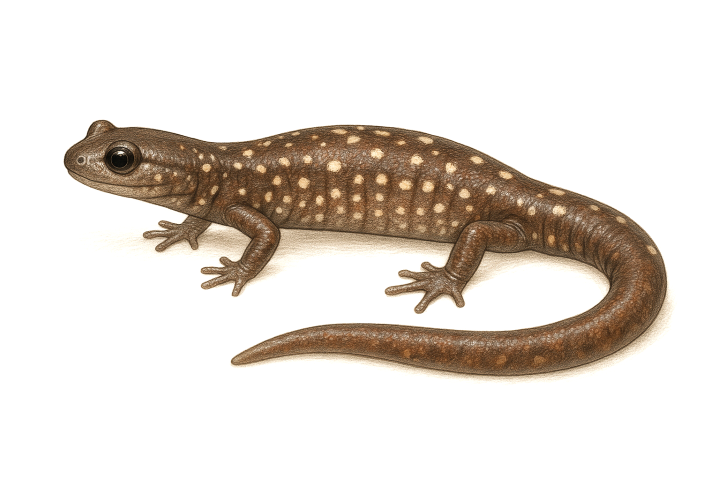
If you ever find yourself hiking through the Ouachita Mountains and happen to spot a small, silky-black salamander with bright markings lounging under a rock or log, you might be looking at the Rich Mountain Salamander. This salamander is not just any amphibian — it’s found only in a very limited area and is one of the true local treasures of the southern United States. Because of its small range and striking appearance, it’s a favorite among herp enthusiasts and conservationists alike.
Size & Physical Appearance
The Rich Mountain Salamander is a fairly small species, usually measuring about 3 to 5 inches long from nose to tail tip. Its base color is typically black or dark brown, often with a scattering of white or brassy flecks along the back and sides that can look like tiny specks of light reflecting off its moist skin.
Along the sides, you can sometimes spot reddish or orange pigmentation, especially on the legs or base of the tail, although this varies between individuals. Juveniles tend to be darker and may lack the full body flecking of adults. Males and females look quite similar, though males might have slightly swollen noses during breeding season due to specialized glands.
Habitat and Range
This salamander is a Ouachita Mountains endemic, meaning it’s found nowhere else in the world. More specifically, it lives in high-elevation forested areas of western Arkansas and southeastern Oklahoma, particularly near Rich Mountain (hence the name), Black Fork Mountain, and parts of the Ouachita National Forest.
They prefer cool, moist environments in mixed hardwood forests. You’ll usually find them hiding under rocks, logs, mossy debris, and leaf litter — especially during cool or wet weather. They tend to stay near permanent springs or seeps in higher elevations above 2,000 feet but can occasionally be found a bit lower depending on moisture levels.
Diet
Like many woodland salamanders, the Rich Mountain Salamander is an opportunistic predator. It loves munching on small invertebrates such as:
- Springtails
- Small beetles
- Mites
- Spiders
- Ants and other soft-bodied insects
They do most of their eating at night or during wet, overcast days when humidity is high. You’re unlikely to see them out actively hunting during hot or dry weather — they wait for the conditions to be just right.
Lifespan
In the wild, Rich Mountain Salamanders likely live for 8 to 10 years, though exact data is limited. Some members of the Plethodon genus have been known to live over a decade in captivity, especially in stable, cool environments with consistent moisture.
Identification Tips
One of the trickiest parts of identifying salamanders in the Ouachita Mountains is that several species live very close to one another and look quite similar. Here are a few key things to help you tell the Rich Mountain Salamander apart:
- Body flecking: Rich Mountain Salamanders often have white or brassy flecks scattered over much of the back and sides. Nearby species like the Fourche Mountain Salamander may look duller or have different speckle patterns.
- Color highlights: Keep an eye out for red or orange coloration on the legs or tail base — a subtle but helpful clue.
- Location matters: If you’re on Rich Mountain or nearby high ridges, there’s a decent chance it’s this species. Other Plethodon species tend to be more widespread or have ranges that don’t overlap much.
If you’re not sure, take a photo (without removing the salamander from its habitat) and consult a local field guide or check with a herpetologist. Always remember that these salamanders are sensitive to disturbance and should be handled as little as possible.
Fun Fact
Rich Mountain Salamanders belong to a special group called lungless salamanders. They breathe entirely through their skin and the lining of their mouth — no lungs at all! That’s why staying moist is so important for them. If they dry out, they can’t breathe properly.
This is also why they’re so picky about their environment. Their need for constant moisture limits where they can live, and it’s part of what makes them such key indicators of a healthy forest ecosystem.
Final Thoughts
The Rich Mountain Salamander may be small and elusive, but it’s a fascinating reminder of how unique and localized biodiversity can be. If you’re ever exploring the forests of the Ouachitas, take a moment to look (gently) under a log or two. With a little patience, you might be lucky enough to meet one of these beautiful little salamanders in person — and now you’ll know exactly what to look for.