
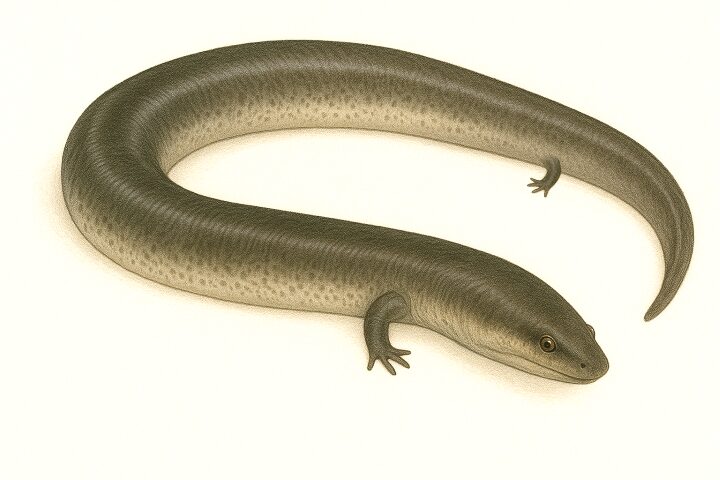
The Three-toed Amphiuma (Amphiuma tridactylum) is one of those creatures that makes you do a double take. At first glance, it might look like an eel or even a small snake — but it’s actually a fully aquatic salamander. This long, slimy amphibian can grow over three feet long, which makes it one of the largest salamanders in North America. But despite its size, it’s surprisingly elusive and rarely seen in the wild. Armed with tiny legs, external gills as juveniles, and lungs as adults, the Three-toed Amphiuma is a fascinating mix of primitive and advanced amphibian traits.
Size & Physical Appearance
These aquatic giants can grow anywhere from 18 to 40 inches long, making them one of the largest amphibians in the U.S. — second only to the Eastern Hellbender.
Their bodies are long, cylindrical, and dark gray, sometimes with a slight purplish or brown tint. They have smooth, slimy skin and four tiny, stubby legs, each ending in three toes — that’s where they get their name. Their legs are so small they’re pretty much useless for walking, but they can help with stability and turning underwater.
Males and females look very similar, though females tend to be slightly larger. Juveniles are basically mini versions of adults, but they start off with external gills which they eventually lose as they mature.
Habitat and Range
Three-toed Amphiumas are found across the southeastern United States, mostly in states like Texas, Louisiana, Mississippi, Arkansas, Alabama, western Tennessee, and parts of Florida. Think of them as creatures of the swamps, bayous, and slow-moving waters.
They prefer stagnant or sluggish aquatic environments — things like oxbow lakes, roadside ditches, rice fields, and swampy creeks. As long as it’s muddy, weedy, and has soft sediment where they can burrow, they’ll feel right at home. They’re usually found at low elevations, close to sea level, and can tolerate some changes in water quality.
Diet
Amphiumas are opportunistic predators, which means they eat just about anything they can catch. Their diet includes:
- Small fish
- Insects and aquatic larvae
- Worms
- Crayfish
- Snails
- Other amphibians (and even other amphiumas!)
They hunt mostly at night and usually strike quickly, sucking prey into their mouths with a powerful vacuum-like action. It may not be graceful, but it’s effective.
Lifespan
In the wild, Three-toed Amphiumas can live for 8 to 15 years, though we don’t know the exact average since they’re hard to study in the wild. In captivity, they’ve lived up to 20 years with proper care, which is impressive for an amphibian.
Identification Tips
It’s fairly easy to confuse the Three-toed Amphiuma with a few other amphibians, especially if you’re just seeing a flash of them in the water. But here are a few tips:
- Check the toes: Amphiumas are the only U.S. amphibians with tiny legs ending in toes. This one has three toes per limb — that’s a key giveaway.
- Look at the size: If it’s nearly 3 feet long and looks like a dark eel with tiny legs, it’s probably an amphiuma.
- Don’t mix it up with a siren: Sirens have similar body shapes and also live in the Southeast. The big difference? Sirens have feathery external gills and only front limbs. Amphiumas lose their external gills as adults and have all four limbs.
Fun Fact
Even though they have lungs, Three-toed Amphiumas can survive for months in dried-up mud during drought conditions. They burrow under the surface, slow their metabolism, and wait for the water to come back. It’s like amphibian hibernation, just in the middle of summer — a behavior known as estivation.
Final Thoughts
If you’re exploring swamps or backwoods bayous in the Southeast and catch sight of a snake-like creature darting through the water, there’s a solid chance it could be a Three-toed Amphiuma. While they’re not often seen during the day, just knowing they’re out there — quietly slurping up crayfish and lurking beneath the mud — adds a layer of mystery to their watery world.
Great for curious students and nature lovers alike, the Three-toed Amphiuma proves that the amphibian world is full of surprises.