
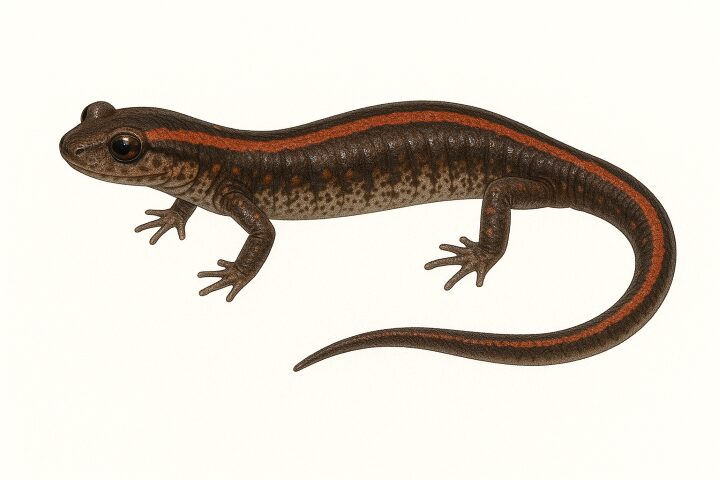
Webster’s Salamander (Plethodon websteri) is one of those little-known gems of the amphibian world. It’s small, blends in easily with its forest floor habitat, and lives a quiet life under logs and rocks. But don’t let its low profile fool you — this salamander plays an important role in its ecosystem and has some unique qualities that make it worth knowing.
Size & Physical Appearance
Webster’s Salamander is pretty small, even by salamander standards. Adults usually measure around 2 to 3 inches long from snout to tail. They have a slender body with short legs, giving them a somewhat delicate appearance.
Color-wise, they’re typically dark brown or purplish-gray on top, with a thin reddish-orange stripe running down their back — sometimes the stripe is broken into spots instead of being one solid line. Their underside is lighter, with a salt-and-pepper speckled belly that’s often black and white or gray.
Males and females look very similar, so it’s hard to tell them apart just by looking. Juveniles tend to have brighter coloring, especially along the dorsal stripe.
Habitat and Range
Webster’s Salamander is mostly found in the southeastern United States, especially in parts of Mississippi, Alabama, Louisiana, and western Georgia. They tend to stick to moist hardwood forests, particularly areas with deep leaf litter, decaying logs, and rocky outcrops.
They aren’t fans of dry conditions, so you’re most likely to find them in shaded, damp forest floors where humidity stays high. They’re usually found at low to moderate elevations, but local terrain — like hills or ravines — can sometimes create the cool, moist microhabitats they need even in warmer areas.
Diet
Webster’s Salamander feeds on tiny invertebrates like springtails, mites, ants, and other small arthropods they find crawling through the leaf litter. They use their sticky tongues to snag prey, kind of like a mini version of a frog.
One neat thing about their diet: because they’re so small, they’re perfectly suited to eating the tiniest critters in the soil ecosystem. That helps keep populations of these invertebrates in check and plays an important role in nutrient cycling in the forest.
Lifespan
In the wild, Webster’s Salamanders are believed to live around 5 to 10 years, though long-term data is limited because they’re so secretive. In captivity, they could potentially live a bit longer, but these salamanders are rarely kept outside of research settings.
Identification Tips
Because they’re part of the large group of lungless salamanders (genus Plethodon), Webster’s can be tricky to tell apart from some of their cousins. To make things easier, here are a few pointers:
- Size & shape: Webster’s is small and slender, usually smaller than sympatric species like the Southern Red-backed Salamander (Plethodon serratus).
- Dorsal stripe: The red or orange stripe is narrower and more variable — sometimes it’s broken up into dots — compared to the broader, straighter stripe on P. serratus.
- Belly color: Webster’s has a distinct salt-and-pepper speckled underside, while similar species often have more uniform or differently patterned bellies.
When in doubt, location helps. If you’re in the heart of its limited range and see one matching the description, there’s a good chance it’s Webster’s.
Fun Fact
Webster’s Salamander doesn’t have lungs — it breathes entirely through its skin and the lining of its mouth. That’s why it needs to live in such moist environments — if it dries out, it can’t breathe properly!
In Summary
Tiny, shy, and tied closely to their forest homes, Webster’s Salamanders are a special part of the southeastern US amphibian fauna. You might never spot one unless you know exactly where to look, but knowing they’re out there, playing their quiet role in the forest floor ecosystem, is part of what makes local biodiversity so fascinating.
If you’re exploring leaf-dappled trails in southern hardwood forests and gently turn over a log, keep an eye out — this little salamander might just be watching you too.